1. PRELIMINARY PREPARATION FOR THE TOURNAMENT 2
1.01 Initial Steps to Follow 2
1.02 Applying for Sanction 2
1.03 Preparing a Tournament Schedule 2
1.04 Tournament Announcement 3
1.05 Entry Forms 3
1.06 Tournament Sanction Fees 4
2. TOURNAMENT COMMITTEES 4
2.01 Tournament Chairman 4
2.02 Tournament Operations - Committee and Chairman 5
2.03 Finance Committee 5
2.04 Grounds Committee 7
2.05 Hospitality Committee 8
2.06 Publicity Committee 9
2.07 Registration Committee 12
2.08 Safety Committee (See IWSF Rule 7) 15
3. OFFICIALS (Refer to Rule 6) 18
3.01 Chief Judge 18
3.02 Appointed Judges 18
3.03 Homologator 19
3.04 Drivers 19
3.05 Scorers 19
3.06 Safety Director (Refer to Safety Director's Manual and Rule 7) 20
3.07 Dock Starter 20
3.08 Meter Readers 21
3.09 Master Board Operators 22
3.10 Runners 23
3.11 Pick-Up Boat Drivers and Riders (Refer to Procedures for Pick-Up Boat Operation) 23
3.12 Announcers 23
4. THE TOURNAMENT SITE AND FACILITIES 26
4.01 Selection of the Site 27
4.02 Tournament Layout 28
4.03 Slalom Course 28
4.04 Construction and Installing the Jump Ramp 29
4.05 Trick Course 31
4.06 Towlines (Rule 10.04) 31
4.07 Towboats (See Rule 10.01) 31
4.08 Gas and Oil 32
4.09 Communications 32
4.10 Electronic Timing 33
4.11 Other Equipment 33
5. GROUNDS 33
5.01 Facilities for Officials 33
5.02 Docks 34
5.03 Bulletin Boards 35
5.04 Other Buildings at the Site 35
6. OPERATION OF THE TOURNAMENT 35
6.01 Familiarization 36
6.02 Starting Time 36
6.03 The Jump Event (See Rule 13) 36
6.04 The Slalom Event (Rule 14) 37
6.05 The Trick Event (Rule 15) 38
6.06 Alcoholic Beverages 39
Figure 1 - General Tournament Site Layout 40
Figure 1A - Overlapped Slalom Course for Short Lakes 41
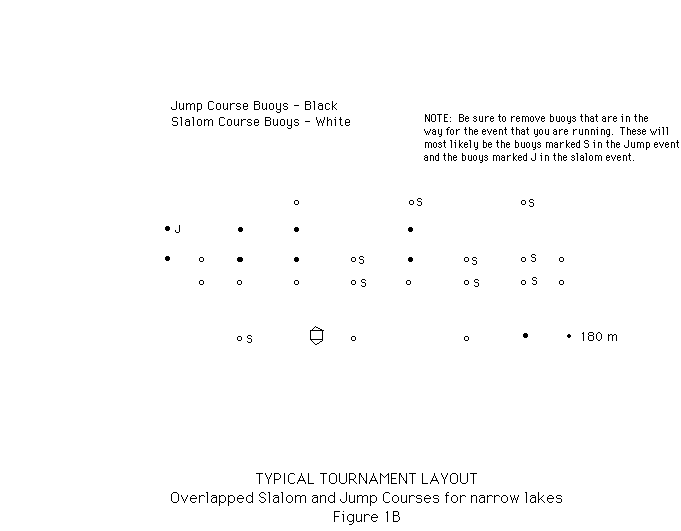
Figure 1B - Overlapped Courses for Small Lakes 42
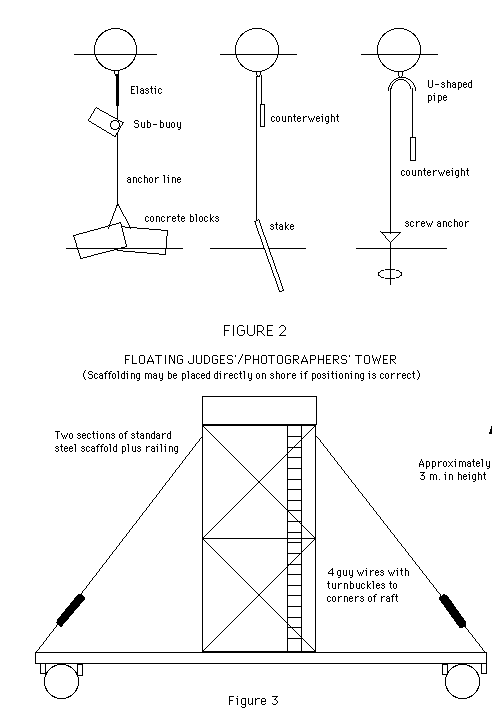
Figure 2 - Buoy Anchoring Methods 43
Figure 3 - Floating Judges Tower 43
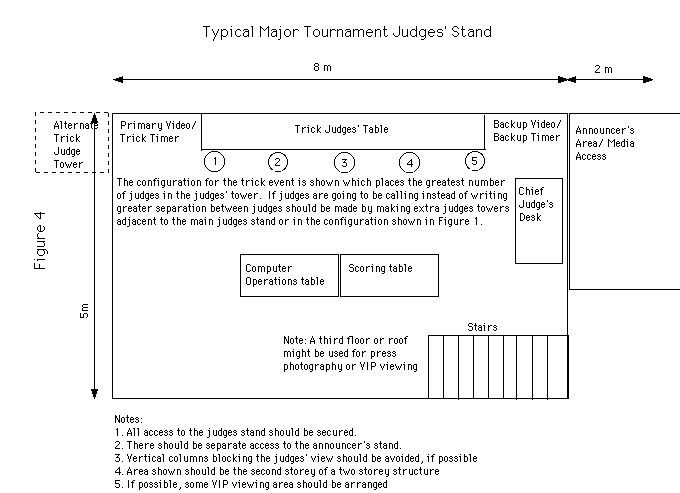
Figure 4 - Typical Judges’ Stand Layout 44
Attachment 1 - IWSF Approved Towboats 45
Attachment 2 - General Pre-Tournament Checklist 46
Attachment 3 - Tournament Event Checklists 47
Attachment 4 - Jump Event Officials’ Forms 48
Attachment 5 - Slalom Event Officials’ Forms 52
Attachment 6 - Trick Event Officials’ Forms 55
Attachment 7 - Tournament Operation Script 56
Attachment 8 - Tournament Schedule 59
Attachment 9 - IWSF Regional Administrations 60
Attachment 10 Homologation Dossier 61
Attachment 11 Familiarization Schedule 68
Attachment 12 Homologator’s Handbook 69
INTERNATIONAL WATER SKI FEDERATION
OFFICIAL WATER SKI TOURNAMENT MANUAL
JUNE 1992
This manual is adapted from the American Water Ski Association Official Tournament Manual. The American Water Ski Association has provided the IWSF with an electronic media copy of the manual as well as permission to modify and distribute it. This manual would not have been possible without the support and encouragement of the American Water Ski Association
The intent of this manual is to provide instruction and reference material for the basic operation of a ski tournament from the local level up to the International Level. Since the manual is meant for use throughout the world, it has been made as general as possible recognizing that the situation my differ greatly throughout the world as far as National Federation Policy and Procedures and Governmental Rules and Regulations. It is always best to work closely with your National Federation to ensure that all the appropriate steps have been taken. Many of the described procedures may either be limited or expanded depending on the specific circumstances.
1. PRELIMINARY PREPARATION FOR THE TOURNAMENT
1.01 Initial Steps to Follow
a. Select a tournament chairman.
b. Locate a suitable site.
c. Decide what class tournament you wish to hold (See IWSF 1991 Rules page 58 for International Classification. The IWSF Regional Administration must be contacted for approval of an International Class Tournament. Consult your National Federation for National or Local Classification).
d. Choose tournament name. You may select any name you wish for your meet; however, no name which implies that it is an IWSF Region or World Championships is permitted unless approved by the IWSF.
e. Clear the date of the tournament with your National Federation. They are interested in avoiding conflicting dates so it is possible that you may be asked to consider an alternate date.
f. Choose your chief judge and other officials. (Note: Procedures for officials selection differ in each IWSF Region and Federation. Contact your National Federation to verify the correct procedure for officials’ selection.)
g. Apply for marine event permit from the local marine authority governing the body of water on which the event is being held, if such permission is required.
h. Apply for any required governmental permits.
1.02 Applying for Sanction
It is desirable to obtain sanction application forms from your National Federation Headquarters as early as possible to meet deadlines and to make sure that materials supplied by the Federation arrive in time. If you are sponsoring your first sanctioned tournament, be sure to work closely with your National Federation to avoid any problems. A special sanction application may be required if you are sponsoring a Record Capability or Cash Prize tournament.
Fill out all sanction application forms carefully being sure to follow instructions. Make note of the deadlines for the return of the sanction application and request for rules exceptions, if any.
1.03 Preparing a Tournament Schedule
Draw your schedule for a two-day tournament so that the first day's events will contain about 60% or more of total competition time. This will allow for unexpected delays, bad weather, etc., and can be accomplished by scheduling more events the first day and/or the long events with the most contestants on the first day. Any events not completed Saturday can be put over to Sunday, but a Sunday event cannot be postponed.
A typical 39-event, two-day tournament might have 20 events on Saturday and 19 on Sunday. If you get behind on Saturday, you can always start earlier on Sunday (after notifying the skiers) than originally scheduled.
How do you know which will be the long events? It is sometimes difficult to predict the number of skiers in various divisions, but in general the men's events will be longest, followed by boys. Normally, female entries will be fewer.
Scheduling experience has proved it best to start each day with a long slalom event.
Do not schedule jump events too early, especially the first day, because of the time required to set up and calibrate the jump meters, measure the jump, etc.
It is always advisable to consult with your chief judge prior to making out your schedule. A club sponsoring a tournament for the first time should definitely do this.
A typical schedule and tournament Operation script is shown in Attachment 7. The amount of time that should be scheduled for each event is discussed in section 6.
1.04 Tournament Announcement
The tournament announcement must contain the following items:
a. Name of tournament
b. Name of sponsoring club
c. Date(s) of tournament
d. Class of tournament
e. Whether open or closed (if closed, state entry qualifications)
f. Skiers' ratings (if required)
g. Location of site and how reached
h. Entry fees, amount and to whom paid
i. Address to which entry is to be mailed
j. Entry deadline
k. Schedule of events including divisions
l. Starting time of first event each day
m. Any approved rules exceptions (Be sure to get approval from your National federation)
n. Name of chief judge
o. If novice events are held, define novice
Additional helpful information:
Whether food will be available at site; nearest accommodations; name and phone number of tournament chairman; special events, if any, when held and cost; whether camping facilities are available; hospitality chairman; banquet information (if held), transportation information, etc.
1.05 Entry Forms
It is desirable to include your own entry form at the bottom of the announcement if they are to be mailed to skiers.
Entry form should contain spaces for:
a. Name of contestant
b. Birth date of contestant and division
c. Address of contestant
d. "Hold Harmless" clause such as following example:
Please accept my entry in the events marked (X) below in the above named tournament. In consideration of your accepting this entry, I hereby, for myself, my heirs, executors and administrators, and/or for the minor for whom I am signing: (1) Release and forever discharge the sponsoring club of the above named tournament, the (your National Federation), and any television broadcasting or news gathering agency that may be assigned rights to cover the tournament, their agents, servants, and all persons connected with these competitions of and from any and all rights, claims, demands and actions of any and every nature whatsoever that I may have, for any and all loss, damage, or injury sustained by me or my equipment or by the minor for whom I am signing or by his equipment before during and after said competitions; (2) grant to the (your National Federation) or its agents or assigns the exclusive right to use any photographs, television pictures or tapes, silent or sound motion pictures taken of me (or the minor for whom I am signing) before during and after above named competitions in connection with the news or publicity coverage of the tournament or in connection with movies of, or the televising of the above named tournament; (3) agree that the(your National Federation) or its agents or assigns shall have the exclusive right to permit, control or prohibit advertising material of any kind on equipment, clothing, or property of the undersigned (or the minor for whom I am signing) used, worn, or displayed at the site of the above named tournament, before, during, or after the tournament.
I or the minor for whom I am signing further understand, appreciate, and accept the potential risk of personal injury inherent in participating in said competitions.
I further understand that the Tournament Committee reserves the right at any time both before and during said competitions to disqualify me and to refuse to allow me to compete in said competitions for any reasons that they in their sole and unlimited discretion deem just and proper and in such event I will be entitled to the return of my entry fee and no more.
(IMPORTANT NOTE: As the above is intended to be a legal disclaimer and laws vary from country to country, please check to see if the above is correct and appropriate for your particular situation.)
e. Signature below d. by competitor, or parent or guardian if contestant is a minor
f. Expiration date of National Federation membership
g. Events contestant is entering
1.06 Tournament Sanction Fees
Check the sanction fee schedule in the sanction application and remit the appropriate amount to your National Federation or other governing bodies as required.
2. TOURNAMENT COMMITTEES
2.01 Tournament Chairman
The chairman of the tournament assumes overall responsibility for the tournament including organization of committees and cooperation with the National Federation and the chief judge. Initial plans, correspondence and important decisions are usually handled by the general chairman with the assistance of his committees. He should make frequent checks on the activities of the major committees for the tournament, making suggestions and corrections wherever necessary.
2.02 Tournament Operations - Committee and Chairman
The Tournament Operations Committee is responsible for all the competitive aspects of a tournament. It is responsible for the tournament site conforming to all National Federation (and IWSF if appropriate) standards and all essential tournament equipment being ready for use.
The Tournament Operations Chairman's first responsibility is to see that the tournament site is fully prepared for the start of competition. Once the tournament begins, the T.O.C. must ensure that all competitive equipment is kept in working order. He must always have extra buoys, anchors, ropes, gas, tools, etc. available for immediate use when needed, so that repair or replacement of tournament equipment can be executed without delay.
During the running of a tournament, the T.O.C. should be sure that all boats, ropes, buoys, etc. are prepared for the event following that which is in progress. The T.O.C. must always be thinking one or two events ahead of the actual competition. It is the T.O.C.'s responsibility to ensure minimum delay between events.
A T.O.C., like a chief judge, should be a person with a thorough knowledge of all National Federation rules and procedures.
2.03 Finance Committee
The work of the Finance Committee is very important in connection with any tournament, and it is highly recommended that a budget be prepared regardless of the size of the meet. The various items in the budget must be estimated very carefully and, where necessary, revisions should be made to keep income and expenditures in line with the budget.
a. Expenses
It is difficult generally to estimate expenses. One sponsor may already have an adequate site, jump, etc., while another club may need to build some of these facilities. Hospitality costs are also subject to great variation. For a weekend tournament, the sponsor may only have a hamburger cookout or a buffet style supper on Saturday night, while another sponsor may have an awards banquet.
Usually the following expenses are standard:
( 1) National Sanction fee
( 2) Local Sanction fees (if any)
( 3) Trophies or other awards
( 4) Accommodations for officials
( 5) Site or equipment preparation or repairs
( 6) Gasoline and oil
( 7) Insurance
( 8) Postage and mailing
( 9) Publicity (posters, signs, etc.)
(10) Printing (tournament announcement, entry form)
(11) Electricity
(12) Hospitality
(13) Sound equipment rental
(14) Towlines
(15) Trick horn/freon
(16) Buoys
(17) Batteries for radios
b. Income
(1) Program ads: Probably the most reliable source of funds because you get the money in advance, regardless of entries or attendance. Most important point in selling ads is to start early.
(2) Entry fees: These seldom realize more than the cost of trophies. Entry fees run from about $15.00 USD to $35.00 USD. Many tournaments have a family rate of about 2 1/2 times the individual entry fee, or a one-event rate of about 1/2 the entry fee.
(3) Food sales: Lots of work for club members, but can produce good returns. Consider concessionaire with percentage to club.
(4) Admission: Not too productive except for major tournaments. May create ill will among friends and family of contestants.
(5) Selling emblems: Generally difficult to recover original cost, which is high for orders of less than 100.
(6) Raffle: Good if you can get prizes donated. Tournament lines can be raffled off or sold for delivery at close of tournament.
(7) Program sales: Sometimes if ads have been sold, programs must be given away to get proper distribution.
(8)..Tournament Rights: At some major tournaments, various rights may be marketable. These might include the boat rights (the right for a manufacturer to have his boat pull the tournament) and TV rights (the right to sell or license the generation and use of any TV signal)
(9) On-site Advertising: Often, companies will pay to have their signs displayed prominently on the tournament site. This is especially true if you can guarantee to the advertiser that there will be TV coverage of your event. Possible locations for such signs might be on the jump ramp or on the various judges towers. In many tournaments, floating signs are put on the water past the slalom course in view of the spectators. If the site is narrow enough, they might be put on the opposite shore from the main spectator area. Remember that safety is a primary concern when placing signs. The placement of such signs must have the approval of the Chief Judge and Safety Director to ensure that they do not interfere with tournament operations and are placed safely.
In many cases, expenses such as trophies, gas and oil, ski jump, etc., can be eliminated or reduced through donations by local merchants and other organizations in return for the publicity they may receive in connection with the tournament.
A financial statement follows indicating the typical costs of a two-day weekend tournament:
1991 Lakeland Open
Receipts
Entry fees - 100 @ $25 $2,500.00
Concession stand 110.00
$2,610.00
Expenses
Sanction fee $90.00
Local Sanction fee (100 x $1) 100.00
Trophies 800.00
Motel for officials 238.00
Site (2 sets buoys, scaffold, towlines) 183.00
Gasoline (250 gal.) 312.50
Registration expense (postage, etc.) 7.20
Printing (entry forms, running orders) 13.00
Hospitality (judges' meeting & banquet) 706.30
Rental (CB radios) 50.00
$2,500.00
Profit $ 110.00
2.04 Grounds Committee
a. Buildings
The Grounds Committee usually has charge of construction and maintenance of all facilities on the site, such as starting docks, boat docks, judges' stands, concession stands, dressing rooms for contestants, restrooms and storage area.
b. Site Improvements
If site improvements are necessary, such as having sand hauled in and spread on the beach area, cutting weeds, having gravel spread in the boat launch area, etc., this will also be the responsibility of the Grounds Committee.
A roped-off area should be provided for the officials and a roped-off area for gasoline storage and fueling. In cooperation with the Publicity Committee, space should be provided for photographers, press personnel, etc. If bleachers have been provided, they should be inspected frequently for safe conditions.
Tables and chairs should be provided for officials, scorers, masterboard, etc. Large umbrellas should be provided to shade meter stations, slalom towers, etc.
c. Traffic
Automobile parking and the handling of traffic in the area are also usually handled by the Grounds Committee. In some instances it may be necessary to clear parking space of weeds, inspect for nails, etc. Several spaces, near the judges' stand if possible, should be reserved parking for tournament personnel and officials. Space should be provided on the site for an ambulance and arrangements made to be certain the ambulance will not be blocked by cars or other obstacles at any time.
d. Utilities
If electricity is not available to the site, it will be necessary for the Grounds Committee to have it installed by the power company or a portable generator will be required. The Grounds Committee is also responsible for drinking water being supplied.
e. Repairs
One important function of the Grounds Committee is to have capable emergency repair personnel immediately available at all times during the running of the tournament. They should have tools and hardware to repair anything at the site which could conceivably break down.
f. Clean up
The Grounds Committee should keep the tournament site clear of refuse by having clean-up details to go over the site one or two times during each day and after the close of each day's activities. An adequate number of trash cans should be provided throughout the site and emptied when full. Dressing rooms and restrooms particularly should be kept clean.
2.05 Hospitality Committee
The duties of the Hospitality Committee vary considerably from tournament to tournament. At one it may involve only obtaining accommodations for the judges and advising available housing for contestants. At another, it may involve banquets, meetings, etc. Therefore, these are general possible duties that could be the responsibility of the Hospitality Committee.
a. Housing
Housing is usually provided for the appointed officials. This may consist of accommodations at a nearby hotel or motel, or in some instances club members may have the officials as house guests. The officials should be notified of the location of the motel and what the Tournament Committee will provide.
Adequate housing facilities for competitors has also been found to be a most important factor in the success of a water ski tournament. The committee should contact motels and hotels in the surrounding area, ascertain the rates, distance from the tournament site, etc., and include this in the tournament announcement. Personal tastes vary; therefore, it would be well to give three or four choices. With more and more people utilizing trailers or campers, having camping facilities at the site is usually very much appreciated. If this is not available, the nearest campsites and rates should be announced.
The local committee is usually aware of a number of choice eating spots. A list of these places would be welcomed by competitors and officials alike.
b. Transportation
Transportation should be provided for contestants and officials between the housing facilities and the site if at all possible. If a number of people will be arriving by air, ground transportation should be arranged for those who will need it. Major hotels and motels may provide a free shuttle service for groups which have booked rooms.
c. Hospitality Kits
If hospitality kits are furnished for the officials and contestants, it is usually up to the Hospitality Committee to secure the kits and contents and assemble them. Some of the items placed in typical hospitality kits are maps of the local area, which can be obtained from the local highway department, city maps, which can usually be obtained from the local chamber of commerce, a tournament emblem, tournament program and various items donated by local manufacturers or national manufacturers, such as sun tan lotion, combs, toothpaste, towels, etc. Donations of these items can usually be obtained by contacting local manufacturers in person or writing national manufacturers, but, again, it is necessary to make your requests several months in advance.
d. Entertainment and Food
At some of the local meets there is no entertainment, while at other tournaments entertainment is quite elaborate. A major tournament, for example, might provide the following:
Lunches for all officials and contestants; two tours of local points of interest (arrangements, transportation necessary); buffet dinner Friday night, followed by a dance (dinner arrangements necessary, location and P.A. system for meeting, location and band for dance, etc.); awards banquet Saturday night (banquet arrangements, M.C. for awards, etc.).
Usually if the entry fee is small, contestants will not expect much in entertainment, but if the entry fee is large, meals and entertainment are anticipated.
Genuine hospitality is one of the most important factors in the success of your tournament. This does not necessarily require elaborate and expensive plans. What it does require is the sponsoring club members making the visiting skiers and officials and families feel like welcomed guests.
2.06 Publicity Committee
The duties of the Publicity Committee usually include:
a. Printing and mailing the tournament announcement
b. Gaining cooperation of newspapers and radio and television stations
c. Programs - advertising, printing and distribution
d. Posters
e. Signs to the site
a. Tournament Announcement
If your tournament announcement is ready well in advance of the tournament, it may be possible to include it in your National or Local Federation Newsletter. Check with the appropriate official for publication deadlines.
The announcements are normally mailed to the prospective entrants. This could be from an International, National or Local Federation mailing list. Remember for other National Federations, you must direct any invitations through the National Federations. The National Federation must be notified of all International invitations.
b. Publicity
The chairman or a member of the Publicity Committee should make an appointment for a personal conversation with the sports editors of local newspapers and radio and television stations well in advance of the tournament. This personal visit is most important, as tournament plans, size and other details can be discussed and definite ideas obtained from the media as to their needs, and the extent of their interest.
Except at large tournaments where reporters are assigned to do stories the publicity Committee will have the job of writing all announcements and stories as well as furnishing accompanying pictures. Committee members who expect to write stories for newspaper publication should study articles printed on sports functions and try to pattern the tournament articles accordingly.
Copy should be typed on white standard typing paper, double- spaced and kept within limits discussed with the editor.
Good newspaper or broadcast copy answers the questions, "who? what? why? when? and where?" in the first two paragraphs. It then goes on to elaborate on these facts in the body of the story. The correct spelling of names is important and all dates and times should be double-checked before submission.
Do the best you can in writing the article but don't be disappointed if it is rewritten or condensed to fit available space.
Many TV stations feature interviews along with film clips of local sporting events. Do not overlook still pictures for showing on TV in the absence of film clips. Good 8 by 10 inch photos and 35mm transparencies will help to illustrate the different events in a water ski tournament very effectively.
Preliminary stories may deal with the announcement of the tournament and plans already formulated by the club. Local people and especially local dignitaries should be given preferential treatment in the articles. Mention can be made of national or state champions expected to compete, but local angles and people should be emphasized. This is especially important in small communities.
Publicity will increase spectator attendance and at the same time win acceptance and recognition for the club. To make the most of a tournament, the member assigned to handle publicity must begin his work well in advance of the actual tournament dates. Good stories do not just happen, they are carefully planned. Steps for the publicity chairman to follow are:
(1) Review the basic plans for the tournament itself. Each event or demonstration may be worthy of a small separate story in itself.
(2) Unless the club has in its membership an expert photographer, a professional photographer should be hired to provide pictures of pre-tournament events for newsmen and for the club's records.
(3) Provide space at the tournament for the working press.
(4) Provide interviews for the press with guests, contestants, champions and winners.
(5) Send special invitations to the press inviting them to be guests at award presentation banquets, kickoff luncheons, etc.
Story possibilities are many. Some suggestions are:
(1) The first story announcing that the club plans to hold a tournament.
(2) Pre-tournament preparations such as building ramps, laying out courses, installation of bleachers, etc.
(3) Individual events and acts.
(4) Local champions and club officers.
(5) Outside skiers scheduled to participate.
(6) If proceeds from the tournament are to go to charity or to a community project.
(7) Other club projects that may be tied in with the tournament, such as water ski safety courses.
(8) Planned publicity, such as presenting the mayor or other civic leaders with water skis, or teaching him to ski.
(9) Wrap-up story after the tournament to cover such items as who won what, records set, number of skiers participating, number of people attending, future tournament plans, etc.
If the tournament is an important one and the club wishes to gain the best publicity possible, a professional photographer should be hired to make and process pictures which are to be used with stories written on the tournament or which may be sent out with only a caption. Photos must be of excellent quality, in sharp focus with plenty of contrast, 8 by 10 inches preferably, and printed on glossy paper. The caption should be short, but should identify all persons shown and should tell something about what is depicted.
Sometimes, as a result of your personal contact with the media, an editor will agree to send a photographer to cover an event. You may also ask some of the competitors to send 8 by 10 glossy photos for publicity use. Most newspapers are cooperative about returning these photos.
Since photography plays such an important part in publicizing our sport of water skiing, it is essential that arrangements be made for advantageous location and opportunity for press and commercial photographers. If possible, a press boat should be furnished. It is essential to assign a driver who is familiar with water ski tournament action. A driver must know where he can and cannot put the boat in relation to the skiers in the slalom and jumping events. A good driver also is aware that when a slalom skier falls at high speed, he sometimes rolls along the top of the water for a considerable distance. When a press boat is to maneuver in the tournament area, permission should always be requested of the chief judge.
The slalom tower is most advantageous for photographers to get good action shots of the slalom event. Since the judges will also be using the tower, it is advisable that not more than two press photographers be allowed on the tower at one time. It is best to have your public relations man set up a schedule for press photographers who wish to use the slalom tower.
If possible, a tower approximately 15 feet high should be erected as close to shore as is possible and near the starting dock. This tower should be exclusively for press photographers so they can use it for shots of the crowd, the take-off and finish of the skiers' runs. With telephoto lenses, a great deal of the tournament can be photographed from such a tower. Care should be exercised that this tower does not interfere with the spectator's view of the tournament.
c. Programs
The Publicity Committee is customarily responsible for the tournament program, its contents, printing and distribution. A significant source of income may be realized from the sale of advertising space in the program to local merchants, especially marine dealers and sporting goods stores.
Some of the material might be on tournament rules, history of water skiing, event records and background material on some of the expected contestants. Other features you may wish to include are pictures, schedule of events, local recognition of committees, etc.
Success in selling programs depends to a great extent upon the number of persons you have covering the spectator area and selling. The program price must be realistic. Sometimes, if ads have been sold, you may decide to give the programs away.
d. Posters
Attractive posters for your tournament can be placed in most marine dealers' windows as well as sporting goods stores, marinas, hotels and motels, tourist attraction centers, chambers of commerce, etc. Bumper stickers are very effective, too.
Perhaps you can arrange displays illustrating the sport of water skiing in cooperation with department stores during the week preceding your meet. If your club has one or two good speakers, you might arrange speaking engagements before local and civic groups in the community. Don't overlook the use of ski equipment and demonstrations in connection with speeches.
e. Signs
The Publicity Committee will ordinarily be responsible for posting signs to direct traffic to the tournament site.
f. Press Facilities
If the tournament is a major one, the Publicity Committee is responsible for providing facilities for the working press such as press trailers, typewriters, telephones, FAX machines, copier, office supplies, etc.
2.07 Registration Committee
The registration of competing skiers will be one of the most important factors contributing to the success or failure of your tournament. This will likely be the arriving contestants' first contact with your group. A helpful, friendly Registration Committee will make a lasting impression. This is particularly so for someone entering a tournament for the first time. For all sanctioned tournaments (except National, IWSF Regional, and World), the handling of applications and checking skiers' eligibility is the responsibility of the local sponsoring group. Otherwise, it is the responsibility of officials assigned by the sanctioning body.
a. Registering
Basically, registration begins with the receipt of the first entry form. As entry forms are received, the contestant's name can be listed on the Contestants' Registration Check List and event forms for each contestant can be prepared. (See "Instructions for Preparation of Forms".) This procedure will greatly simplify the actual registration of contestants when they arrive at the tournament site.
The experience of veteran tournament chairmen points out the advantage of closing entry lists at least one day in advance of the start of the tournament. Late entries, unless the tournament is on a very small scale, serve only to add unnecessary work to the already busy program of the Registration Committee.
Drawing for running order should be made after the entry deadline (IWSF rule 2.05). All forms may then be completed, and forms placed in consecutive order according to the drawing for that event.
Members of the Registration Committee should be on hand at all times at least the day before the start of the tournament. They should sign in contestants, check National Federation membership cards, check rating cards, obtain five copies of trick lists, etc.
Each contestant must present to the registrar his National Federation card and his rating card if a rating is required for this class tournament. If a contestant does not have some proof of current membership with him, he may be permitted to purchase a membership and the dues forwarded to the National Federation. No contestant is permitted to enter a sanctioned tournament without written proof of membership.
A skier may present a signed but uncertified rating card to the tournament registrar. A temporary rating receipt can be issued and the contestant will be qualified to ski.
The Registration Committee should take care that all National Federation membership applications and fees, as well as all rating cards and fees, are promptly forwarded to the National Federation and temporary receipts given to the skiers because often they will need to have proof of membership and rating.
It is most important that the Registration Committee be on duty at least one hour before the start of the competition. The majority of the contestants will be arriving to register during this time. If sufficient personnel is not available, contestants may not have time to register and have National Federation membership and rating cards checked in order to ski. This is particularly true if late entries are being accepted, in which case forms have to be made out, starting lists changed, etc., for each late entry.
Check list of supplies:
Pencils (2 doz. minimum) Scotch tape
Stapler Clipboards
Thumb tacks Federation Membership applications
Entry forms Temporary Membership Receipts
White paper Carbon paper
Paper clips Temporary Rating Receipts
Waste basket Scissors
Pencil sharpener Other small office supplies
b. Instructions for preparation of forms
Note: These are general procedures for preparing tournament forms. More detailed instructions are not given due to the wide differences in tournament organization and handling. Sample Forms are attached for your reference.
All forms should be prepared prior to the arrival of the chief scorer.
(1) Assign a file folder for each event. Arrange file folders in a box or suitable container according to the order of events; i.e., junior girls' slalom, junior boys' slalom, etc.
(2) As entries are received, fill out the event forms for the contestant and place in the proper folder; i.e., five copies of trick score forms.
(3) As soon as the entry list has been closed and drawing has been made for the order of contestants in each event, enter the names of the contestants in each event in the proper order in the master scorebook, the meter and master board forms, slalom score sheets, etc. Place the trick scoring forms in the proper consecutive order.
(4) If possible, photocopy sheets indicating the starting order for distribution to contestants, spectators and officials. If this is not possible, make at lease seven copies of the running order of each event. These will be for the chief judge, the dock starter, the announcer, the bulletin board, an extra file copy, etc.
(5) Place all the completed forms necessary for each particular event in the file folder for that event. For example, in the junior girls' slalom file folder, forms would be:
5 copies of slalom judges forms (1 for each judge) (Rules for local tournaments may allow three Judges instead of five.)
1 Slalom Recap Form
7 copies of running order of contestants
In the junior girls' jumping file folder would be:
3 copies of meter forms (one for each meter station)
1 copy of master board form
7 copies of running order of contestants
1 copy of jump timer form
In the junior girls' trick folder would be:
5 sets of judges scoring forms (1 set for each judge)
7 copies of running order of contestants
(6) As the declared trick lists are filled out by contestants and received, they should be attached to the trick forms by the contestant's name. (Note: Regional practice varies on whether to include the skier’s declared list for each judge to view before the skier skis.)
(7) There will be various other forms, such as the Judges’ Rules Compliance Form,.for use of the chief judge. Make a file folder to hold these miscellaneous forms.
(8) Have all these completed forms available for the chief judge in correct order so that he or she or an assistant can distribute them as needed. Have score books ready and give them to the chief scorer.
(9) Remember, for each late entry you must fill out trick forms, jump forms, add contestant's name to slalom list, meter reading list, master board list and 7 running order lists. Check with the chief judge to ascertain where the late entries will ski. Usually they are added to the front of the running order and ski first in the event.
(10) When the tournament is completed, mail all memberships and signed rating cards to National Federation along with the proper fees. One check may be forwarded to cover the total amount of cash that was collected for memberships and ratings. It is the responsibility of the chief judge to return all judges', drivers', scorers' performance reports, etc. It is the responsibility of the chief scorer to return one copy of the scorebook to the National Federation. International Classification tournaments require that a copy of the scorebook (and/or homologation dossier) be sent to the IWSF Regional Authority.
2.08 Safety Committee (See IWSF Rule 7)
The tournament sponsor should appoint a safety director, who may or may not be a member of the sponsoring organization. Quite often, however, the safety director is chairman of the Safety Committee.
In any event, the usual duties of the Safety Committee are to:
a. Be responsible for supplying pick-up boats during competition. Pick-up boat personnel should be thoroughly briefed on emergency safety measures, where they are to be stationed, etc.
b. Check the water bottom for stumps, submerged pipes, glass, etc., particularly in the take-off and landing areas. All dangerous items should be removed or clearly marked.
c. Check the shore area, being especially careful that all broken glass, nails, tin cans and such have been picked up. Bleachers, if any, should be periodically inspected for safety. The gasoline source should be kept fenced or roped off. Electrical wires should be placed so that no one can contact them with wet feet or hands.
d. See that adequate transportation (ambulance or station wagon with stretcher) is available to transport skier to a hospital in the event of an accident.
e. Maintain a first-aid station with bandages and other first-aid supplies.
The safety director shall be responsible for the safe conditions of all equipment, facilities and operation of the tournament. He shall determine whether equipment to be used by contestants meets safety requirements. The safety requirements are:
a. No skier shall be allowed to compete, or to continue to compete, if in the opinion of the safety director and two- thirds of the event judges, his competing would be a danger to himself or other skiers in the tournament. During the competition, the safety director may at any time request the chief judge to halt the tournament for a poll of the judges in regard to any skier's actions or condition.
b. Skis must be safe. There must be no unnecessary sharp or abrasive metal, wood, or other attachments to the ski which would, in the safety director's opinion, inflict possible injury to the skier should he come in contact with the ski in a fall.
c. Flotation devices must meet the specifications outlined in Rule 7.03 and must be worn by all contestants in slalom and jumping.
d. At least one (two are recommended) pick-up boat shall be used during all events. The boat must contain a driver, and crewman wearing a life vest and swim suit. Please pay special attention to IWSF Rule 7.07 regarding operation of the Safety Boat. It states that "in international competition, language difficulties may interfere with communication; and, for this reason, the swimmer MUST GET IN THE WATER to assist the injured skier."
The safety director's and Safety Committee's job ends when all boats have been put away and when the beach has been cleared of contestants and spectators; not when the tournament is over.
TOURNAMENT COMMITTEES AND ORGANIZATION
Tournament
Chairman
|
Facilities |
Grounds |
Finance |
Hospitality |
Publicity |
Registration |
Safety |
|
tournament layout |
judges’ stands |
budget |
officials housing |
tournament announce-ment |
receiving entries |
pick-up boats & equipment |
|
slalom course |
scorers’ area |
contestants housing |
newspaper |
forms preparation |
safe condition of site |
|
|
slalom towers |
start dock |
INCOME |
food |
radio/TV |
checking federation membership |
first-aid supplies |
|
jump |
landing dock |
program ads |
transport-ation |
photography |
office equipment |
ambulance |
|
meter tables |
boat dock |
entry fees |
entertain- ment |
press facilities |
bulletin board |
dock starter |
|
masterboard |
gas dock |
concessions |
food |
programs |
returning memberships |
ski checker |
|
trick course |
bulletin board |
admissions |
hospitality kits |
posters |
returning rating cards |
gas safety |
|
towlines |
restrooms |
donations |
concession stands |
signs |
returning collected fees |
controlling boat traffic |
|
towboats |
dressing rooms |
announcers |
Safety Report |
|||
|
gas & oil |
storage area |
EXPENSES |
||||
|
commun- ications |
bleachers |
sanction fees |
||||
|
flags |
press facilities |
trophies |
||||
|
horn/ whistle |
parking |
hospitality |
||||
|
video |
utilities |
gas/oil |
||||
|
timing system |
trash cans |
insurance |
||||
|
clean-up |
printing |
|||||
|
public address system |
postage |
|||||
|
equipment |
||||||
|
etc. |
||||||
|
FINANCIAL STATE- MENT |
Note: The Facilities and Grounds Committees together are refered to as Tournament Operations.
3. OFFICIALS (Refer to Rule 6)
3.01 Chief Judge
One of the most important factors in the success of your tournament is the ability and leadership of the chief judge. The chief judge is responsible for the proper conduct of all competitive events. He conducts each event in accordance with National or IWSF rules. He will double check all tournament site equipment to be sure that all specifications are met. He will work closely with the tournament chairman to see that events keep moving in an orderly manner without undue delays and that the tournament is completed in the allotted time.
A 1st Class Judge (highest level) is desirable as chief judge. A local judge has the advantage of being readily available to consultation and advice before the tournament date. If you do not know a judge for this position, consult with your National Federation who will assist you.
Work as closely as possible with the chief judge beforehand and consult with him regarding your proposed schedule of events, judges, facilities, personnel, etc. It is also important to have the chief judge at the tournament site no later than the day before the tournament to look over the site and anticipate problems that may arise.
3.02 Appointed Judges
There are Regional differences around the world in the procedure with appointed judges. As a matter of definition, an Appointed Judge is one who votes on starting speeds, protests, speed tolerances, etc. An Event Judge only has authority for the event in which he is involved and votes on matters like reride requests that come during the running of the event.
The two principle systems are as follows:
In one system, only a few Appointed Judges are named and Event judges are drawn from these judges and other judges in attendance. In this system there should be at least three Appointed judges.
In the other system, all the judges invited to the tournament are Appointed Judges and they also serve in all cases as the Event Judges.
Either of these may be used or modified to allow more Appointed Judges in the first case or allow non-Appointed Judges to be Event Judges in the second case.
Judges are classified differently around the world as well. Usually, the highest rated judge is a 1st Class Judge or International Judge. There are different levels of International Judge as well as levels of National Judge.
For International Tournaments, specific levels of judges are required to meet International sanction requirements. They are listed on page 58 of the 1991 IWSF Rule Book. National or local tournaments will have National or local requirements.
3.03 Homologator
The Homologator is the official responsible for certifying that all of the technical site requirements have been met according to the rules. As such, his job is mostly performed before the start of the tournament. He must, with appropriately assigned assistants, survey the competition courses, measure the ropes, verify the jump meter system, verify the timing system as well as a large number of other technical details. He will record all of this information in the Homologation Dossier which will be sent to the appropriate sanctioning authorities. Please note that all sanctioned tournaments must have some level of homologation. This varies by Region so please consult your National Federation for the appropriate level of homolgation required. A sample homologation dossier and more detailed description of the homologator’s specific tasks are included in an appendix of this document.
3.04 Drivers
No single factor can cause more protest and dissatisfaction among skiers than a poor towboat driver. It is vital to the smoothly run tournament to obtain the finest drivers available.
The chief driver and the driver for the first event each morning should arrive at the site at least 30 minutes before starting time. They should see that the boat is operating properly and has been fueled and run time checks so that the towboat can be at the starting dock several minutes before starting time.
For International Tournaments, specific levels of drivers are required to meet International sanction requirements. They are listed on page 58 of the 1991 IWSF Rule Book. National or local tournaments will have National or local requirements.
3.05 Scorers
A chief scorer manages the scoring tabulations and is responsible for all aspects of scoring and calculating as well as the official scorebook. Event scorers shall be selected by the chief scorer from other scorers in attendance at the tournament, subject to the approval of the chief judge. For a three-event tournament with 80 contestants or more, at least two scorers will be needed. In fact, whether you have that many entries or not, it is best to have two scorers so that they may check each other's work and thus avoid an error that could necessitate an embarrassing apology. Additional scorers should be considered if dual events are scheduled. In recent years the use of computers for scoring has become widespread. It is important that the computer program that will be used is one that functions properly. This can be assured by either using a commonly used program already in existence or by thoroughly testing any new program this is proposed to be used. It is very important that the Chief Scorer be thoroughly familiar with the program. Often, one person is given the responsibility of operating the computer. It is best if more than one of the scorers is capable of operating the scoring computer. It is best if the computer is a portable type that can run without external power. For complete safety, there should also be a backup computer in case the primary computer fails. The same computer, or a different one, may be used for jump distance calculation.
Duties of the scorers are to:
a. Receive all judges' score sheets.
b. Check for disagreement and resolve same, consulting chief judge if necessary.
c. Compute points as prescribed in Rules 5, 13, 14 and 15.
d. Enter scores in the scorebook.
e. Compute overall scores and enter in scorebook.
f. Post results for public review.
g. Be sure scorebooks are sent to the proper authority for the Class of tournament being held.
For International Tournaments, specific levels of scorers are required to meet International sanction requirements. They are listed on page 58 of the 1991 IWSF Rule Book. National or local tournaments will have National or local requirements.
3.06 Safety Director (Refer to Safety Director's Manual and Rule 7)
At least two weeks before a tournament, the sponsoring affiliated club shall appoint a safety director. The safety director will work with the Safety Committee and will appoint such assistants as are necessary. He shall be responsible for the safe conditions of all equipment, facilities and operation of the tournament. he shall have the authority to take whatever action is necessary, including stopping the tournament, whenever he observes a condition he believes unsafe. However, the chief judge may overrule any contemplated action or decision of the safety director.
The safety director shall determine whether contestants' equipment meets safety requirements.
The safety director must fill out the Safety Director's Report and return it to the proper authority (usually the National Federation) after the tournament, even if there were no injuries.
3.07 Dock Starter
The starting dock is one area that needs to be taken seriously in the preparation of a tournament. Some tournaments simply break down if the dock starter doesn't have his job under control at all times. The dock starter's most important job is getting the right skier in the water at the right time. This may sound easy, but under tournament conditions it sometimes becomes difficult.
The dock starter may be one of the sponsoring club members, or may be designated by the chief judge as someone at the tournament who is a judge or who is working to become a judge.
The sponsor should have at least two or three people available who have been thoroughly briefed on how to handle this position in the event they are needed. A dock starter should always be on hand for the first event each morning. This starter should check in with the chief judge and then report to the starting dock at least 30 minutes before time to insure that the first skiers are on hand, etc.
In general, the dock starter's duties are as follows:
a. Obtain a running order from the chief judge's stand. Check for any official scratches or late entries. Report to the starting dock at least 30 minutes before the estimated start of the event. Check communications with the chief judge's stand. Call the roll of contestants. This serves to remind the contestants of their starting order. If the first four or five contestants are not on hand, report this to the judges' stand so the skiers can be told to report to the starting dock. This advance preparation by the dock starter can save those delays between events that sometimes occur at tournaments.
b. Safety. The dock starter serves the important safety function of seeing that the proper flotation is used by contestants in jumping and slalom. He may also be assigned by the safety director to check skis and other equipment for safety.
c. Lines and Handles. He is responsible for having the proper towlines on hand and for determining the skier's choice of handles legally available (Rules 10.05 and 10.06). He should also insure that contestant-owned handles meet specifications (Rules 10.05 and 10.06).
d. Timing. He should have a watch and be responsible for timing the one additional minute of time for emergencies just prior to the contestant's turn to ski (Rule 2.04), and the five-minute rest period before rerides (Rule 8.03). Read and know the relevant rules !
e. Starting. The dock starter must be sure that the skiers are ready and in the water for their skiing turn, with skis and flotation devices on when the boat arrives to pick them up. he should always have the next two skiers on deck with their equipment is readiness. For efficiency the skier should be in the water with ample room for the towboat to pass so that the skier can catch the trailing rope and the boat can be off without undue delay. If a rope change is necessary, attaching the skier’s personal handle to a spare rope can allow the new rope to be handed to the boat as it goes by the dock to eliminate any delay.
Equipment check list: order of contestants, ropes, handles, boat hook for lines, watch, tape measure, rule book and communications device.
The dock starter should have the authority to keep the dock clear of all but his dock assistant, the starting contestants and the necessary gear.
A dock starter should strive to remain calm, be fair, and know the rules.
3.08 Meter Readers
For jumping events, two meter readers will be needed for each meter station. Thus, if three meters are being used, six readers will be necessary. It is advisable for the sponsor to have several persons in their organization--rated judges where possible--practiced in reading meters in the event they might be needed by the chief judge.
To sight the jump, the arm is moved from the center of the top edge of the jump to the point directly beneath the skier's heel at the instant of landing. This point is usually indicated by a plume of water rising after the skier's landing.
Extreme care should be taken in sightings and readings. The scale on the meter should be read to the nearest division by the upper and lower reader. After readings are obtained, the sights are not to be moved, so that in the event of a recheck, the operators may refer again tot he meters and recheck their readings.
For manual masterboard operation, it is recommended that the operator of the upper sight or a third party should be responsible for figuring the average of the two readings. He should immediately communicate this average to the master board operator using intercom, telephone or other suitable communication. Metering is done in decimal degrees, with each reading done to the nearest .2 degree. Thus, averaging of top and bottom readings will be accomplished without rounding off. The readings and average are recorded on the individual sight meter record. If there is greater than a 1/2 degree difference between the readings, report this to the masterboard along with both readings.
If a computer masterboard is used, both upper and lower readings are reported to the masterboard. Also in this case, readings may be taken to .1 degrees.
During the tournament the chief judge or his assistant will assign meter readers for each jumping event. Several minutes prior to an event, each reader should report to the judges' stand, pick up the sight meter form and report to their designated meter. This will allow the meter reader time to check his meter, check the communications, etc. and be all set to go at the conclusion of the event presently on the water. It should never be necessary for the announcer to have to remind the meter readers to report to their stations. During the event, it is of the utmost importance that readings be made quickly, averaged quickly and communicated quickly to the master board. Remember that the contestant must be informed of the approximate distance after each scoring jump. If the readings are delayed, then the tournament must be delayed until the reading can be given to the skier. After the event, the form should be turned in to the scorers.
For International Tournaments, specific levels of judges are required on the meters to meet International sanction requirements. They are listed on page 58 of the 1991 IWSF Rule Book. National or local tournaments will have National or local requirements.
3.09 Master Board Operators
If a manual master board is used, it is recommended that it be operated by at least two persons, with possibly a third handling the communications and recording the information on the master board meter record form. One individual on one side of the board should operate the arms, and the other person should read the distance at the intersection of the strings or plastic arms, then communicate the distance to the announcer or whoever is notifying the contestant.
In most cases, computers are used to calculate distances. The same computer might also be serving as the scoring computer (see section 3.04). If a computer is used, there should be a back-up computer (or manual masterboard). The back-up computer should be a portable type, not requiring external power. In this way, a site power failure will not stop the tournament. The tournament Homologator or Chief Judge must verify that the program being used passes the computer benchmark in the IWSF Rulebook.
As readings are received from the meter stations, for a manual system, the operator will move the arms to lie along the correct degree readings on the corresponding protractors. In general, the arms will intersect at a point on the distance grid between two distance lines. The distance is to be read to the nearest 10 cm Where the lines intersect half way between two lines, the distance will be read to the next higher 10 cm increment. For a computer system, the operator will enter the readings into the computer which will show the results of the jump as well as any possible options created by a large triangle reading.
The length of a jump is determined by the inscribed circle of the triangle formed by the three meter readings. See the IWSF Rulebook Rule 13 for a complete description of inscribed circle. (See your National Federation Jump Meter Manual for complete details.)
Use of a computer masterboard is highly recommended, and in fact required for International Tournaments.
3.10 Runners
The sponsor should have several people who will serve as "runners" during the tournament and should schedule the event each will be handling. It is helpful to the scorers to receive the forms immediately after every contestant in the trick events, so a runner, supervised by the assistant scorer, is needed for these events to go to each judge, pick up the completed forms and take them to the scorers. Youngsters may be assigned to do this, but if so, they should be cautioned on the importance of not losing a form, picking the forms up promptly, etc. It is also helpful to the scorers if runners turn in the forms in 1-2-3-4-5 order.
3.11 Pick-Up Boat Drivers and Riders (Refer to Procedures for Pick-Up Boat Operation)
The sponsor should furnish sufficient pick-up boat personnel. Two pick- up boats will be required for jumping and slalom and two are recommended for tricks, although not mandatory. The rider should have on a flotation device and should be ready at all times to jump in to assist a skier. It is recommended that crews be relieved at least every two hours since it is difficult to stay alert in the hot sun hour after hour.
The pick-up boat crews assigned to the first event each morning should be on hand at least 30 minutes prior to starting time, so that they can gas and check out their boats and be in their positions before starting time. Their assistance may also be needed in ferrying judges to slalom towers, etc. Crews assigned to later events should report to the safety director approximately 30 minutes prior to their event, so they too can get their boats checked out and into position on time.
Where the skier has taken a normal fall, idle slowly over to pick him up (do not make even a ripple if you can help it). Where the skier has taken a bad fall, get to him quickly, but don't head straight in on him. It is better to get to the side of the skier and have your rider check him or, if necessary, jump in to be sure he is all right. When idling, keep the bow of the boat pointed toward the course so that the wake of the towboat does not bounce off the side of the boat causing rollers.
It is emphasized that, in international competition, language difficulties may interfere with communication; and, for this reason, the swimmer MUST GET IN THE WATER to assist the injured skier.
Official towboats should not be used as pick-up boats.
3.12 Announcers
Often two or three people in the sponsor's organization can serve as announcers. If so, they should be familiar with the operation of tournaments and have a knowledge of the rules. Appointed judges sometimes can assist with the announcing duties. However, quite often they will be too busy to assume this added responsibility so an announcer and relief announcer should be provided by the sponsor. Suggestions for the announcers follow:
As the announcer, you are the only link between the contestant, the audience and in some cases, the judges. Above all, you should be informative. You can interject occasional humor as a sort of bonus, particularly during delays that occur in most tournaments. There are many show-off type skiers who love to act humorously on the water. The announcer can give the crowd a number of laughs if he knows the skier is going along with him. However, comedy should not be overdone. It is far better to be strictly informative than strictly entertaining, but a blend of both is desirable.
Never, of course, interject humor or other side commentary and announcements at the expense of the contestant's time in the performing area. If, by your neglect or oversight, you should be announcing some information other than what the contestant is doing and you fail to recognize his brief appearance, you will be doing the contestant an injustice. Remember that the tournament is for the contestant--give him his due.
It isn't necessary to be a professional announcer to do a good job of commenting. You should have a better than average knowledge of water skiing fundamentals and above all you should be enthusiastic in your presentation. Don't apologize for your announcing shortcomings. No one expects you to be a professional. What an audience deserves and should expect is a knowledgeable account of what is happening, who is skiing, a little of the skier's personal and skiing background and some basic explanation of the event in which the contestant is taking part.
This format for tournament announcing has proved helpful and successful:
a. Introduce yourself.
b. Welcome contestants and spectators to the tournament.
c. Give chief judge's name, name of host club and tournament director's name.
d. Announce the day's events.
e. Announce first event and event particulars (i.e., rule book description, event records, event personnel, such as boat drivers, judges, secretaries, runners, etc.)
f. List contestants and scratches.
g. Give contestant particulars (i.e., personal background and skiing history).
h. If contestant is not on starting dock, announce the one-minute time limit.
i. Limited comment on skier's actual performance.
j. List the personnel for the next event above five or 10 minutes before the event in process ends.
k. Give necessary "nuisance" announcements at proper times.
l. Point out safety features employed for event.
m. Give previous event results, when official.
n. At conclusion of event, acknowledge efforts of boat driver, pick-up boats, etc.
o. Introduce next announcer.
p. At conclusion of day's event, announce events for following day and starting time plus any changes in schedule.
q. At conclusion of tournament, acknowledge host's efforts in staging the tournament and thank the persons who deserve the appreciation of all contestants.
Regarding the actual calling of each event, each announcer should have his copy of the latest Official Tournament Rules and should recite at least the general ruling governing each event he calls. He can go into more detail should time permit. He must know the rules in order to explain such things as reruns, balks, scoring, etc.
He should point out boat speed, rope length, ski description, rating and classification standards and records of each division for the event. Course specifications should be mentioned. Don't attempt to second guess the meters or the judges. Inform the audience that everything coming over the public address system pertaining to the contestant's performance is unofficial unless otherwise designated.
In tricks, hold descriptive chatter to a minimum after mentioning that the contestant is about to enter the course. You can explain certain tricks beforehand or in between performances. You can point out the fact that the contestant is wearing two skis or one ski, that the contestant is attempting toehold or wake tricks. A high-point trick run is very difficult to call accurately and there is the added risk of being accused of second-guessing the judges. It is like describing a boxing match to a TV audience. You don't call every punch because the people can see what is happening right in front of them.
Of the three events, the slalom event is often considered the least exciting from the spectator point of view. The announcer should not call each buoy achieved, but he might point out at which buoy the run was concluded if the contestant falls. He should point out the boat speed for each succeeding run, and the rope length.
Jumping is unquestionably the most spectacular of all the events. There should be absolutely no talking during the contestant's last five or so seconds before touching the ramp. This helps to build up the tension and suspense of the event. The safety features, jump side reflectors, life vests, pick-up boats, etc., should be pointed out as well as the jump specifications and division records.
One problem in tournament announcing is the many necessary nuisance announcements you have to handle. These include lost-and-found reports, move-the-car requests, lost child announcements, you-are-wanted-on-the phone announcements, food-and-drink-is-available announcements, gratuity acknowledgments, and social event and meeting announcements in conjunction with the tournament. One way to keep such announcements at a minimum is to have them go through a secretary for screening. The secretary can type or write the information on a slip of paper and include the time and date to avoid confusion, misrepresentation or duplication. Clipboards will help organize the various announcements to be made.
Your audience will contain persons from varied walks of life. It is your duty to respect the sensibilities of contestants, parents and others. Your comments must be in good taste and your language appropriate.
The public address speakers should be placed to cover both spectator and tournament areas. Distances attained during jumping events must be relayed to the contestants, and requests to boatmen viewing the proceedings from the water to hold down their boat speed may be necessary from time to time.
Check the loudness of the system. You want the spectators to hear you but you don't want to blast off their ears.
The contestants make the tournament and the more information you can pass on about each skier, the better informed and the audience will be and the more interest will be shown in the skier. Make a special effort to announce names correctly. To aid the announcer provision can be made on the back of the tournament entry form for a complete skiing history plus some personal background on the competing skier. This information, of course, should be supplied by the skier when he applies for entry in the tournament and should cover such topics as tournament experience and placement in specific tournaments; highest trick run total; best effort in slalom; longest jump; event liked best and why; number of years skiing; ski club affiliation; hobbies and occupation.
The skier's address, age, division and current rating are usually found on the standard tournament entry form.
Variety is the spice of tournaments, too. If possible, secure the services of three of four commentators to handle the day's events. Even the best announcer gets tired after several hours at the mike. And when he is tired, he gets boring. Your voice reflects your attitude, so watch it. If you are irritated, it is apparent in your voice. If you are tired, bored or indifferent, your voice reflects this. Enthusiasm is a must in announcing. Speak distinctly and slowly enough for the audience to hear what you have to say. The PA system may dictate at which speed you can speak. Give it everything you've got and the contestants and the audience can expect no more.
Don't overplay miscues. Even the best of champion skiers goof and come up with lumps. Don't over describe an accident. Humans have a certain attraction for the morbid, but use common sense in such emergencies.
The IWSF on down to the smallest ski club stresses the importance of safety in water skiing. As the announcer, you cannot talk enough about safety. Announcers should point up the many safety features observed in a tournament--the pick-up-boats, observer, flotation equipment, ski jump side aprons, strict standards for skis, the "OK" signal from a fallen skier, the first-aid station and ambulance-in-waiting, etc.
If at all possible, directions and instructions to pick-up boats, judges, meter readers, etc., should be imparted via the walkie-talkies or citizen-band radio equipment. The announcer shouldn't handle information of this type unless the radio equipment is out of order, or unless requested to by the chief judge. Such information has little appeal to the spectator audience.
The following or similar announcement for your National Federation memberships should be repeated several times each day:
"Many of you viewing this tournament are not familiar with the (Your National Federation) which sanctions this tournament.
The (National Federation) is the national organization of water skiers which sanctions many tournaments each year, each tournament being carefully planned to fulfill the requirements for top-rated competition.
Anyone can join the National Federation. You don't have to be a skier. Ask a member of the Club sponsoring this tournament (or visit the National Federation exhibit for a membership blank."
4. THE TOURNAMENT SITE AND FACILITIES
In preparing for a tournament, the importance of selecting a proper site and assuring proper facilities for the slalom, jump and trick events can not be overstated. Many things can go wrong during a tournament and the skiers and spectators will forgive and forget, but a poor tournament site or an improperly laid slalom course or a poorly constructed jump ramp or a faulty trick course will spell disaster for any tournament.
In this portion of the manual, selection of the tournament site is discussed and specific details are provided for laying out the slalom course, constructing and installing the jump, and setting out the trick course. Few clubs are ever in a position to provide the ideal site and tournament facilities, but by becoming aware of ideal conditions, it is hoped that clubs, especially those putting on a tournament for the first time, will be able to make the most of what they have to work with and avoid the numerous pitfalls which can hurt tournaments.
Please note that in section 4 of this manual there are many references to water depths, lengths, and distances for safe skiing. These distances represent a sampling of actual experienced sites rather than a mandated figure to guarantee absolute safety. The IWSF makes no guarantee, implicit or explicit that conforming to the distances, depths, etc. in this section will eliminate all possible safety hazards.
4.01 Selection of the Site
For a good tournament site, a sheltered lake or inlet is preferred over open bodies of water or rivers. "Sheltered" means a ski area surrounded by high banks and/or a heavy wooded area which would lessen the effect of any wind on water conditions. Consideration should be given to the direction of the prevailing wind. If possible, select a site where the wind will blow across the tournament course, rather than down it. With the exception of heavy rain, the most devastating element at a tournament is rough water. The possibility of a contestant being injured through loss of control in rough water is much greater, and the performance of the skiers in general will be sub-standard. Water should be closed to all traffic except tournament boats. If a private lake is used, controlling traffic and random wakes is relatively simple. On public lakes, bays or rivers, it is often possible to enlist the aid of local authorities. If the traffic cannot be properly controlled, it is best to select another site, no matter what other advantages may be offered. Water depth should be at least 1.5m and in the area forward of the jump in excess of 2.0m A careful survey of the site must be made to assure that there are no pieces of broken glass, tin cans, sharp stones, protruding pipes and stakes, or any underwater objects which would present a safety hazard. The bottom should gradually slope up to the shore line. Steep banks rock or cement block walls create excessive backwash which can cause bad water conditions. Floating debris can also present problems. Large pieces of floating trash create a safety hazard to skiers and boats, while smaller debris can interfere with a skier or clog pilot tubes. However, debris in limited amounts can usually be controlled effectively by patrol boats.
Ideally, the tournament site should be at least 600 m long and 100 m wide to allow adequate room for the course and for the boat to turn around at either end. There should be a minimum of 150 m of approach space on either end of the slalom course and a 360 m approach to the jump. Typically, the jump is placed so that no shore point or obstruction is closer than 40m. The slalom course is usually placed no closer than 20 m to a shore point or obstruction. The trick course can be placed within 15m of shore or an obstruction. Please note that these are typical observed distances and do not guarantee absolute safety.
If possible, the tournament course should run north and south to eliminate facing sun glare on the course in the early morning or late evening (This is , of course, dependent on latitude and should be examined for your particular site). However, first priority should be given to selecting a site with favorable wind and water conditions.
Skiers and ski tournament officials have found that while a river is adequate for pleasure skiing, currents tend to pull the slalom buoys out of alignment and river traffic can be difficult to control. However, numerous successful tournaments have taken place at suitable river locations.
A tournament site should be readily accessible by road. There should be adequate parking, shelter and other facilities to accommodate participants as well as spectators who will be attracted by the competition. Restrooms should be located near the spectator area. There should be a bathhouse or some similar structure nearby to provide competitors a change area.
Hotel, motel, camping site, or similar accommodations should be fairly near to the site. Transportation, such as a shuttle bus, should be supplied if housing is more than a few blocks from the site.
4.02 Tournament Layout
A properly laid out tournament course assures that every skier gets an equal break and allows the skier to perform his best. One possible tournament layout is shown in Figure 1. It should be noted that this is only one of many possible layouts. This particular setup was chosen because it requires the minimum length body of water. Other advantages are that it consolidates all of the skiing in one area, thus simplifying the tournament operation and providing for better spectator viewing. Other tournament layouts are shown in Figures 1A & 1B with overlaping courses.
It is recommended that the complete tournament layout be installed at least the weekend prior to the actual competition and tested thoroughly. There will be many last minute tasks for the sponsoring organization without having to install the slalom course or anchor the ramp the day before the action starts. Any trouble spots can be spotted in advance and corrections made.
4.03 Slalom Course
The slalom course is by far the most difficult of the three courses to lay out. Each of the 22 required buoys must be placed with considerable precision. The layout and distance between buoys are stipulated in the 1991 IWSF Rule Book, diagram 1 (page 64). For a Record Capability tournament, the slalom course must be surveyed.
If shallow water conditions permit, it is best to secure the buoy lines with pointed stakes or screw anchors into the bottom. If this is impossible, then anchors made from several concrete blocks or five- gallon can filled with concrete are adequate. If blocks are used, tie them together with heavy wire. Polyethylene or polypropylene 1/4-inch diameter line is best for buoy lines. It is best to "sub-buoy" at each anchor; that is, a buoy should be tied approximately three to four feet under the surface of the water. This buoy is helpful in locating the buoy line if the floating buoy is lost, sunk, or is removed during the tournament. Sub-buoys are especially helpful in deep water where divers cannot reach the anchor to secure a line. Plastic bottles or the equivalent, half filled with water, or 6-inch blocks of styrofoam make ideal sub-buoys. Contact your National Federation for information on purchasing official slalom buoys. These are not too expensive and are designed specifically for tournament use. Surface buoys must be inflated so that they fall within the tolerances spelled out in Rule 14.06. In securing these buoys to the sub-buoy, a stretch line should be used. This can be shock cord, or 1/4 to 1/2-inch wide rubber bands made from inner tubes and looped together are excellent for this purpose. Use of the stretch line makes the buoy less sensitive to being pulled out if hit by the boat, skier tow rope or ski handle, and provides for keeping the buoys floating at a proper level in spite of currents, wind, boat wakes, or even variations in the water level, (Figure 2).
Numerous techniques can be used to lay out the course. For more complete details, check the booklet "How to Lay Out a Slalom Course" which may be obtained from the IWSF Tournament Council, 23 Fox Hollow Road, Voorhees, New Jersey, 08043, USA.
a. Slalom Towers (see Rule 14.05)
Slalom towers are platforms approximately 1.2 m square or larger, raised above the water surface. Height should be approximately 3m.
Towers may be floating or fixed to the bottom. Water depth is the determining factor here. Construction should be such as to allow boat wakes to pass freely without creating backwash and to protect the judge from prevailing wind, if possible, (Figure 3).
At some tournament sites, the towers may be installed on dry land. The same height above the water will be required.
Towers should be located on each side of the slalom course as shown in Diagram 1. They should be approximately 20 m outside the line of skiers' buoys on opposite sides of the course. It has been shown to be helpful for observation of the skier passing through the entrance gates if the tower is on a line of about 45 degrees to the starting gates.
In addition to a judge, a tower may be used by a backup timer. Some communication device must be supplied, such as radio, telephone, intercom or as a last resort, number boards.
4.04 Construction and Installing the Jump Ramp
One of the major responsibilities of the sponsoring club is to make sure that the jump is soundly constructed and the jump course is properly set up. This assures that any spills during jumping competition are a direct result of the skier's ability and are not caused by a poor jump ramp.
A complete set of plans for the construction of a jump can be ordered from the IWSF Tournament Council, 23 Fox Hollow Road, Voorhees, New Jersey, 08043, USA. If these are followed, then a good ramp is assured. The difference in building a good jump and a superior jump can only be brought about by applying years of experience in tournament work and in jump construction. To deviate from the basic plans without this experience usually ends in trouble. Under no circumstance should a club attempt to cut corners by using cheap materials or questionable construction techniques.
A good measure of jump ramp stiffness and floatation can done quite easily. A good benchmark is that a person (70-80kg) standing on the high end of the jump should not cause the jump to sink more than 5 cm. This criteria is very important and will allow the jumpers to perform at their best.
Installing the jump and course is relatively simple if a few basic steps are followed. The proper course dimensions are given in the 1991 IWSF Rule Book diagram 2 (page 65). The most difficult task is locating the jump properly in relation to the guide buoys. The following procedures can be used to install a jump course with right-hand approach only.
a. Install all eight boat guide buoys. Assure that the buoys are in line and are the correct distance apart and are the correct colors as prescribed in the rules. Care should be used in locating the jump course in relation to the slalom course (see Figure 1).
b. Measure from the inside boat guide buoys and establish a parallel line of buoys: one temporary "positioning" buoy where the center of the lip of the ramp will be, one temporary "sighting" buoy opposite the timing course entry buoy and both skier cut-out buoys.
c. Locate around the "positioning" buoy the four anchors to be used in securing the jump. The anchors should be located so that when the anchor lines are attached to the jump, an angle of approximately 45 degrees is formed between the line and the surface of the water and between the line and the leading edge of the jump platform. The anchor lines should cross each other under the ramp. This and all of the preceding steps should be accomplished before the ramp is ever moved into place.
d. Float the jump into place and locate the middle of the forward part of the jump directly over the "positioning" buoy. Secure the two forward anchor lines to the forward part of the jump.
e. The next and most difficult step is to align the jump with the course and secure the back anchors. This is accomplished by a person standing on the forward platform and sighting from forward to aft along the center line of the ramp surface. The aft end of the jump is then swung around using the anchor lines until the center line of the jump lines up with the "sighting" buoy and the cut-out buoys. This sighting procedure is helped somewhat if a person holds a pole in a vertical position in the middle of the aft end of the ramp. Once aligned, the aft anchor lines should be secured and all lines checked to assure that the jump will not come loose from the anchors.
f. When the jump is securely anchored as described, the two temporary buoys can be taken out. It is recommended, however, that these buoys be sub-buoyed three to four feet beneath the surface rather than completely removed. This will assist immeasurably in relocating the buoy lines if for some reason the jump shifts and it is necessary to realign the jump with the guide buoys.
The makeup of the guide buoy anchors and line should be similar to those for the slalom course. Sub-buoys are also recommended to assist in finding the anchor line in the event the surface buoy is lost.
Anchors used for securing the jump must be heavy enough to assure that the jump will not "drag anchor" as a result of strong winds. Half sections of 55-gallon drums filled with rock and concrete or the equivalent are the minimum size anchors which should be considered. Large screw anchors may also be used if bottom conditions permit. Half- inch polyethylene or polypropylene lines make good anchor line and are easily manageable. Remember, as in the installation of the slalom course, setting out the jump is an easy matter if proper equipment and personnel are on hand before you start.
Water must be supplied to the jump. If a water supply is available from the shore, the simplest way to get water to the jump is to run a water hose from the supply source to the ramp. Care must be taken that the hose is well weighted down. The other method most commonly used is a small gasoline or battery powered pump.
Proper waxing of the ramp surface is most important for good performance and safety. Unless your ramp has been very recently waxed, it is recommended that it be waxed several days before the tournament. Consult with your National Federation on the proper wax. A fiberglass surface ramp may or may not need to be waxed. In some cases, automobile wax can be used effectively.
Once the jump is anchored into position, the remaining task is setting up the meters and master board. Complete instructions for accomplishing this are contained with the set of meters, sighting arms and master board which should be ordered from your National Federation. The are also available from the IWSF Tournament Council, 23 Fox Hollow Road, Voorhees, New Jersey, 08043, USA.
a. Meters
The Johnson system for measuring distance in water ski jumping is based upon principals of geometry and trigonometry applied through the use of two or three sighting stations located on or near the shoreline. These stations measure the angles from the jump to the point of the skier's landing. This information is then interpreted into distance either on a manual master plotting board or a computer. The master plotting board is simply a scaled representation of the jump and relative position of the meter stations. The computer program is a mathematical implementation of the scaled model and recommended. International classified tournaments require the use of the computer. Complete details of meter setup and operation are included in the Johnson Jump Meter Instruction Manual available from the IWSF Tournament Council, 23 Fox Hollow Road, Voorhees, New Jersey, 08043, USA.
The entire meter and distance computing system should be set up and tested no later than the day before the tournament. To aid in testing a computer system setup, a benchmark test is supplied in the 1991 IWSF Rule Book on page 66. Then if difficulties arise, there is time to remeasure and make corrections. Do not wait to do this until the morning of the tournament when there are many other important duties to be performed without this additional task.
4.05 Trick Course
Installation of the trick course is a simple matter. It is simply four buoys in a straight line centered on the trick judging towers. Check the IWSF Rule Book Diagram 3 for the exact dimensions to be used The buoys, anchor, line and sub- buoys should be similar to those used in the slalom course.
4.06 Towlines (Rule 10.04)
The tournament sponsor must furnish single-handle, 23-meter towlines made of quarter-inch polypropylene rope. See Rule 10.04 for complete specifications. Two slalom lines (21.5-meter sections with standard loops) and two jump lines (21.5-meter sections) together with four handles with 1.5-meter bridles are sufficient for most three-event tournaments. Lines at a Record Capability tournament must be checked by the Homologator with a 20-kg. scale as per Rule 10.04. Trick lines and handles are furnished by contestants.
4.07 Towboats (See Rule 10.01)
Adequate towboats are among the most important essentials of a successful tournament. The boats must be capable of sustained high- quality performance at the required speeds. The best choice is boats that have been certified by the IWSF (See Attachment 1). If these boats are not available then other boats meeting the general criteria stated may be used. Only IWSF Approved Boats may be used at tournaments directly sanctioned by the IWSF. Check with your specific IWSF Region for its specific policy of towboat specification.
Two or three boats capable of better than 40 mph are desirable. It is also desirable to have a choice of inboard, outboard or I/O boats for trick contestants, if possible. Factory promotional boats often can be obtained by contacting manufacturers.
At least three additional boats are needed to pick up fallen skiers, to check measurements, to transport officials from judges' dock and starting dock, to serve as the floating press box for visiting representatives of the press and broadcast media.
Since most boats are donated for use, it follows that they must be handled with care. Tie them securely when not in use and make sure they are safe between events or while stored overnight.
Two accurate speedometers and two pick-ups are required for towboats.
Speedometers should be the type with large faces which have accurate readings at trick speeds of 10 to 18 mph and should be attached to the boat directly ahead of the driver and near his line of vision.
Ski pylons should have tops designed for easy attachment of towline loops.
4.08 Gas and Oil
The amount of gas and oil to be consumed will, of course, depend upon the number of events and the types of boats. The usual procedure for a gas supply is to have the local distributor deliver one or two large portable tanks to the site. The tanks are equipped with adequate hose and manual pumps for delivering the gas to the boats. In the cases of boats requiring mixed fuel, be certain that the proper mixture of gas and oil as specified by the boat owner is used. The gas supply must be in a safe location, away from spectators who may be smoking, and yet be readily accessible to the boats. Having one or two persons in complete charge of refueling boats is advisable. Be certain all gas storage tanks are adequately marked. Care should be taken against theft of gasoline and/or oil after tournament hours.
4.09 Communications
Adequate communications are an absolute necessity for the successful operation of a tournament. Faulty and garbled communications can cause numerous delays.
Good communications are vital between the judges' stand and several other stations. These include towboat, starting dock, slalom towers, and master board. Phones or intercoms with wires are best for land lines. Towboats and slalom towers generally use citizens band or FM radios, or several walkie-talkies on the same channel.
Communications should be set up and tested completely several days before the start of the tournament so that corrections and repairs can be made if necessary. Walkie-talkies should be tested in the boat with the motors running, particularly if outboard motors are being used. In addition, communications should be re-checked each morning prior to the start of the tournament.
Walkie-talkies sometimes fail to perform at various times during a tournament, but this can be avoided by using fresh batteries each day.
4.10 Electronic Timing
Top level International Classification tournaments as well as others specified by your IWSF Region or National Federation require automatic electronic timing. Several commercial systems are available. Most work on the principle of detecting submerged magnets in the courses to start and stop the timing intervals. If you are not familiar with where to obtain such a system, contact your IWSF Region administration for this information (See attachment 9).
4.11 Other Equipment
A list of additional essential equipment follows:
a. Red and green flags (four of each)
b. Horn or whistle for tricks
c. Grease pencils for marking skis
d. Number cards or chalk and blackboard for displaying jump distances (alternately, the distance is radioed to the boat judge who informs the skier by hand signals)
e. Tape measure for checking ramp
Added equipment certain to be useful:
a. Boat cushions
b. Ice water coolers
c. Extra towlines (with and without loops)
d. Extra anchors
e. Extra buoys
f. Extra line (for roping off areas, etc.)
g. Supply of old towels or rags (for wiping up after a rain)
h. Water pail (in the event of difficulty with the ramp water supply)
i. Plastic covering material for the meter stations in the event of rain.
A checklist for a tournament setup is included in attachment 2.
5. GROUNDS
The Grounds Committee is usually responsible for various land facilities on the site.
5.01 Facilities for Officials
a. Judges’ Stand
Provisions should be made for a judges' area that is inaccessible to the public. This may consist of simply a rented tent in a roped off area or it may consist of a judges' stand.
Ideally, the judges' stand could be as large as 8m by 8m. Across the front, a counter 1 m wide and table high should be constructed. It should be as close to the water's edge as possible and raised to such a height that there would be no possibility of any person obstructing the view of a seated official. The stand should have a roof with a generous overhang in front to shield judges from sun or rain. A typical judges’ stand for a major tournament is shown in Figure 4.
Whatever type of judges' area is furnished, it should be equipped with one or two tables and several chairs, with a public address system for the use of the announcer, and telephones or radios to enable officials to contact the starting dock, other judges' towers, towboats and master board. Electricity must be supplied. Several clipboards, pencils, pencil sharpener, trash can, etc., will also be needed.
For major tournaments either as part of the judges’ stand or a separate area, a video review area/ meeting room should be provided. This will be used to review video’s that have disputed trick scoring and also may be used as a judges’ meeting room to discuss protests, disciplinary measures or other confidential matters.
b. Trick Judges' Stands
Roped-off areas or stands should be provided for the five event judges. These should each be equipped with two chairs for the judge and secretary. Umbrellas for shade are much appreciated by officials.
It is also common to have all of the trick judges work out of the main Judges’ stand. In this case, there must be enough room so that each judge has enough room and he/she does not disturb the adjacent judges. This is most commonly done where the judges are writing their trick runs rather than calling them to a secretary. When the judges write the runs, they do not need a secretary (one fewer person) and they do not interfere with other judges since they are silent.
c. Scorers
The scoring table is sometimes located in the judges' stand. If so, it should be situated so that the scorers will have adequate privacy in order to work uninterrupted. Scoring facilities also should be protected from wind and rain. Often an air conditioned trailer is obtained for use of the scorers.
Equipment that will be needed by the scorers includes calculators (electricity for these), pencils (black and red), erasers, paper clips, staplers, pencil sharpeners, thumb tacks, trash can and other office supplies.
d. Master Board
A table must be provided on which to place the manual jump master board or computer system. The master board/computer system is often set up in the judges' stand. If not, communications must be provided from the master board to the judges' stand.
5.02 Docks
Dockage in the immediate tournament area should be provided for all official boats. No boats other than official tournament craft should be allowed in the tournament area or at the tournament docks.
The starting dock should be located so that towboats may proceed as quickly as possible into the slalom, jump and trick riding courses without leaving a disturbing wake. It is often necessary to have a separate starting dock for the slalom and trick or jump courses. It is a time-saving feature to have separate take-off and landing docks, so that a contestant can swing off and drop at the landing dock and the boat can proceed to the take-off dock and pick up the next contestant.
All docks should be kept clear of skis, lines, clothing and other equipment. An assistant at the starting dock should have a boat hook to catch the towline.
Good communications between the starting dock and the judges' stand are essential. Some sponsors use phones or intercoms and also have radios for back-up.
An additional dock or area should be provided for fueling the boats.
5.03 Bulletin Boards
There should be bulletin boards at the tournament site and tournament headquarters on which all scores, starting order of contestants and other information relevant to the tournament will be posted for the information of the contestants and the press.
5.04 Other Buildings at the Site
Dressing rooms and toilets are of the utmost importance and are a must for any major tournament. If permanent facilities are not available, portable toilets may be rented. If the concessions are to be operated by the sponsoring club, some provision must be made for constructing or setting up concession stands.
Storage should be furnished for supplies, i.e., towropes, extra buoys, tools, etc.
Bleachers or stands may be needed. In some areas, it might be possible to borrow or rent portable stands. For the large tournaments, stands of ample capacity are essential. Check on the club's possible legal liability before using bleachers.
If admission is charged, ticket booth should be provided at all entrances.
Press facilities in the form of a trailer or separate room equipped with desks and chairs will be needed if the tournament is a major one. Telephones, FAX machines and typewriters should also be provided.
A registration area should be equipped with at least one table, several chairs and conventional office supplies. It should be clearly marked so it can be easily located by the arriving contestants.
6. OPERATION OF THE TOURNAMENT
For a weekend tournament the facilities should be ready at least one full day before the starting time. Slalom buoys, the jump, jump meters, starting dock, judges' stand, etc., should all be in place. For a Record Capability tournament, i.e., International or National tournament, the slalom course must be surveyed in accordance with IWSF and/or National rules. Representatives of the tournament committee should be on the site from the time the arrival of the first contestants is anticipated. This is particularly true for the Registration, Tournament Operations and Safety Committees.
The day prior to the start of the tournament the chief judge should arrive to review the set up. He will check or have the appointed judges check the tournament facilities. The slalom course should be checked by sighting and by measurements. The height and length of the jump both under and above water should be checked. The jump should be examined for condition of surface wax, any nails or sharp edges, side panels securely in place and to make sure that it is well anchored. The meters and master board/computer system should also be checked.
6.01 Familiarization
It should be noted at this point that some tournaments allow or are required to have familiarization. Familiarization is specified in the IWSF Rule Book Rule 2.06. Basically, if familiarization is required, the minimum that must be given each contestant is the opportunity to ski over the ramp. If time allows, each contestant might be given the opportunity to familiarize himself or herself with the courses in all three events. Usually, some fixed increment of time is given to each skier to use as best as possible. Familiarization is run by the Chief Judge. Needless to say all on water preparations must be complete before familiarization can start
6.02 Starting Time
The day of the tournament, it is very important that all tournament personnel report to the site early; an hour before starting time is suggested. There are always last-minute details to be handled, boats timed, judges ferried to their positions, late arrivals registering, etc. Often, a forerunner is sent out to test the readiness of the facilities and officials just prior to starting the event. At the appointed starting time, the first skier should be leaving the dock. Many contestants come from long distances, yet they must be ready by the starting time or miss the event. It is certainly the responsibility of the sponsor to also be ready by the starting time.
6.03 The Jump Event (See Rule 13)
a. Setup Requirements
See Attachment 4 for Jumping Forms
The following personnel are required for the jump event:
Two event judges Six meter readers
(can double as meter readers, Master board operator and assistant
master board operators or Scorers
boat timers in local Dock starter
tournaments) Runner
Boat judge Back-up timer
Boat driver Someone with number boards to indicate
Boat timer distances to the contestants or procedure to
Announcer allow boat judge to tell skier the distance
(Rules require that approximate distances shall be communicated to the contestant after each scoring jump.) A driver and observer wearing swim suits and life jackets are required for each of the two pick-up boats.
Be sure that measured and approved towlines are at the starting dock. Each of the judges must be given a clipboard, pencil and jump scoring sheets. All of the meter readers must have their forms at their meter. Don't forget the back-up timer or communication equipment which must be tested for working order.
b. Event Narrative
Before starting the jump event, all officials and equipment must be in place and communications working. This is usually verified by a checklist. A sample can be seen in attachment 3. Often, a forerunner is sent out on the course, just before starting to verify that all is ready. The forerunner might get only one jump if everything is working properly.
Meanwhile, the dock starter is telling the first skier to be ready when the boat with the forerunner returns as he/she will be leaving immediately. The dock starter checks that the skiers equipment has been checked by the safety official. If the skier has a personal handle, it may have been already checked or the dock starter can check it with a handle checking fixture at the starting dock. The dock starter should attach it to one of the spare ropes and hand the new rope to the boat crew when the boat returns for the first skier and take the rope just used.
When the boat returns, the first skier should be ready to go. However, the skier will not proceed until the Chief Judge authorizes the start of the event. Once the event starts, the event operation should be very repetitive in that each skier is picked up, skis his or her turn and is returned to the dock. Efficiency in dock operation is very important. Even a 30 second delay can add up to a long time if it happens for every skier. Typical jump event operation might take 5-6 minutes per skier in a two jump preliminary round and 7 minutes per skier in a three jump final round. This time should be carefully monitored and operations adjusted if it is not being met.
When the event is over, all event change operations should be begun. These things include officials change and course changes if required. Boats should also be fueled. One common operation for large events is to add fuel to the boat 5 gallons at a time during the event to keep a consistent level of fuel in the boat for all contestants.
6.04 The Slalom Event (Rule 14)
a. Setup Requirements
See Attachment 5 for Slalom Forms
The following personnel are required for slalom:
Four tower judges Announcer
(or two at local tournaments) Scorers
Boat judge Dock starter
Boat driver Back-up timer
Boat timer At least one pick-up boat with driver,
and observer wearing life jacket
and swim suit
Best scheduling dictates that each day's program starts with slalom and it is imperative to have all personnel mentioned above at the site at least one hour before the event commences. Remember that the boat crew will have to check the speedometers through the slalom course at proper speeds. Each and every person who will be working the event should be contacted the night before to make sure they will be on hand ahead of starting time. Here is a spot where your tournament can get behind right at the start, so begin the first event on time!
Be sure that measured and approved towlines are at the starting dock. Each of the judges must be given a clipboard, pencil and slalom scoring sheets. If slalom towers are in the water, the tower judges must be ferried to them. Don't forget the back-up timer or communication equipment which must be tested for working order.
b. Event Narrative
Before starting the slalom event, all officials and equipment must be in place and communications working. This is usually verified by a checklist. A sample can be seen in attachment 3. Often, a forerunner is sent out on the course, just before starting to verify that all is ready. The forerunner might get only two passes if everything is working properly.
Meanwhile, the dock starter is telling the first skier to be ready when the boat with the forerunner returns as he/she will be leaving immediately. The dock starter checks that the skiers equipment has been checked by the safety official. If the skier has a personal handle, it may have been already checked or the dock starter can check it with a handle checking fixture at the starting dock. The dock starter should attach it to one of the spare ropes and hand the new rope to the boat crew when the boat returns for the first skier and take the rope just used.
When the boat returns, the first skier should be ready to go. However, the skier will not proceed until the Chief Judge authorizes the start of the event. Once the event starts, the event operation should be very repetitive in that each skier is picked up, skis his or her turn and is returned to the dock. Efficiency in dock operation is very important. Even a 30 second delay can add up to a long time if it happens for every skier. Typical slalom event operation might take 5 minutes per skier in a preliminary round and 5 1/2 - 6 minutes per skier in a final round where performances are expected to be better and include more passes per skier. This time should be carefully monitored and operations adjusted if it is not being met.
When the event is over, all event change operations should be begun. These things include officials change and course changes if required. Boats should also be fueled. One common operation for large events is to add fuel to the boat 5 gallons at a time during the event to keep a consistent level of fuel in the boat for all contestants.
6.05 The Trick Event (Rule 15)
a. Setup Requirements
See Attachment 6 for Trick Forms
Personnel required for tricks:
Five event judges Announcer
Five secretaries (if required) Scorers
Boat judge Dock starter
Boat driver Runner to collect forms
Shore timer At least one pick-up boat
Back-up timer
The Tournament Committee and the chief judge should determine, well in advance of the first trick event, the most efficient boat path to be followed in the trick events. Such factors as the location of the starting dock, the direction of the first pass, the skiers' landing area, and peculiarities of the site (backwash, limited turning area, etc.) should all be considered in establishing an efficient boat path so that the trick event can be held in a minimum amount of time.
It should be remembered that tricks is the most flexible event. If delays are encountered and the tournament is going to extend into the twilight hours, a trick event should be scheduled as the last event. Slalom and jumping are run at higher speeds and visibility and safety are key factors in determining when these events should be scheduled.
b. Event Narrative
Before starting the trick event, all officials and equipment must be in place and communications working. This is usually verified by a checklist. A sample can be seen in attachment 3. Often, a forerunner is sent out on the course, just before starting to verify that all is ready. The forerunner might get only two passes if everything is working properly.
Meanwhile, the dock starter is telling the first skier to be ready when the boat with the forerunner returns as he/she will be leaving immediately. The dock starter checks that the skiers equipment has been checked by the safety official.
When the boat returns, the first skier should be ready to go. However, the skier will not proceed until the Chief Judge authorizes the start of the event. Once the event starts, the event operation should be very repetitive in that each skier is picked up, skis his or her turn and is returned to the dock. Quite often in the trick event, two boats and boat crews are used so that while one skier is on the water, the next is being readied at the dock. As soon as the course is ready, the next boat may go. Efficiency in dock operation is very important. Even a 30 second delay can add up to a long time if it happens for every skier. Typical trick event operation might take 4 minutes per skier. This time should be carefully monitored and operations adjusted if it is not being met.
When the event is over, all event change operations should be begun. These things include officials change and course changes if required. Boats should also be fueled. One common operation for large events is to add fuel to the boat 5 gallons at a time during the event to keep a consistent level of fuel in the boat for all contestants.
6.06 Alcoholic Beverages
Alcoholic beverages including beer must not be consumed during or immediately preceding a sanctioned tournament by officials or contestants at the tournament site or other location, to the extent that it impairs their mental or physical faculties which are required for satisfactory performance of tournament duties and responsibilities, that it imperils the safety of contestants or others in attendance or where it creates a flagrant or unwholesome spectacle.
Those violating the above rule may be summarily relieved of all tournament duties by either the chief judge or the tournament chairman for the remainder of the tournament or until such time as the situation is corrected.
Figure 1 - General Tournament Site Layout
Figure 1A - Overlapped Slalom Course for Short Lakes
Figure 1B - Overlapped Courses for Small Lakes
Figure 2 - Buoy Anchoring Methods
Figure 3 - Floating Judges Tower
Figure 4 - Typical Judges’ Stand Layout
Attachment 1 - IWSF Approved Towboats
IWSF Approved Towboats
Saturday, January 4, 1992
*Revised Tuesday, February 25, 1992
The following is a list of IWSF approved boats:
Pan American Region
American Skier Boat Corp. Brendella Boats (Shortline Comp only)*
Mike Brendel
301 Enterprise Dr. 2556 W. 16th Street
Ocoee, FL 34761 USA Merced, CA 95340 USA
Correct Craft, Inc. Fineline Industries
Larry Meddock Rick Lee
6100 South Orange Ave. 455 Grogan Ave.
Orlando, FL 32809-4610 USA Merced, CA 95340 USA
MasterCraft Boat Co. Ski Supreme
Chuck West John Crowe
Rt.9, Box 152 1103 12th Ave. East
Maryville, TN 37801 USA Palmetto, FL 34220 USA
European Region
Figlas Boats Fa. Boesch Motorboote
Medellin Seestrasse 197
Colombia CH-8802 KILCHBERG
Switzerland
Asian-Australian Region
Comaro Inboard Guilflite Inboard
Flightcraft 18XLT Inboard Mr. David Gill
Flightcraft 18XLT Outboard 58-60 Vinter Road
Camero Ski Boats Croydon, VIC 3136
Mr. Dick Smith AUSTRALIA
11 Kitawah Street
Lonsdale, S.A. 5160
AUSTRALIA
Lewis Inboard Success Inboard
Mr. Steve Parker Mr. Ron Brauer
Lewis Ski Boats Success Craft Boats
50 Antoine Street 119 North Street
Rydalmere, NSW 2116 Toowoomba, QLD 4350
AUSTRALIA AUSTRALIA
Fibermaster/Malibu
Mr. Sam Catanese
826 Mountain Highway
Bayswater, VIC 3153
AUSTRALIA
Attachment 2 - General Pre-Tournament Checklist
On-Water
1. Slalom course - judging positions ___
2. Location of jump ___
3. Jump course ___
4. Trick course ___
5. extra buoys, ropes, anchor, etc. ___
6. boat patterns ___
7. Safety boat locations ___
Off-Water
1. Starting Area ___
2. Slalom judging positions ___
3. Trick judging positions ___
4. Jump judging positions ___
5. Equipment for each event ___
6. Meter tables/computer ___
7. Scoring/registration area ___
8. Announcer location ___
9. Scoreboard (jump distance) ___
10. Refueling activities ___
11. Tournament ropes/handles ___
12. Audible device for tricks/backup ___
13. Boat flags ___
14. Awards area ___
15. Results copying ___
16. Results/notices/announcements posting ___
17. Trick scores release area ___
Safety
1. ambulance ___
2. safety equipment checklist ___
Communication
1. PA system ___
2. FM radios towers/boats ___
3. meter table communications ___
Equipment Checklist
1. Official slalom ropes ___
2. Official jump ropes ___
3. Official handles ___
4. Red & Green flags ___
5. Audible device for tricks ___
6. Backup device for tricks ___
7. Masterboard computer ___
8. Backup computer ___
9. 100m measuring tape ___
10. check safety boats ___
11. trick video primary ___
12. trick video backup ___
13. endcourse video 1 ___
14. endcourse video 2 ___
Attachment 3 - Tournament Event Checklists
(One check list for each event, each time it is run)
Slalom Pre-Event Checklist
EVENT:Men Slalom Seeds 7,6
1. Ropes and handles (3) ___
2. Red/Green flags (2) ___
3. Officials forms ___
4. start lists ___
5. radios ___
6. gas/oil ___
7. official towboat ready ___
8. Pickup boats staffed & ready ___
9. End course video 1 ___
10. End course video 2 ___
11. Scoring computer and backup OK ___
12. Spare Bibs at dock (if required) ___
Trick Pre-Event Checklist
EVENT:Men Tricks Seeds 6,5
1. Red/Green flags (2) ___
2. Trick timer/audible device ___
3. Backup timer/audible device ___
4. Video 1 ___
5. Video 2 ___
6. Scoring computer and backup OK ___
7. Spare Bibs at dock (if required) ___
8. Start lists ___
Jump Pre-Event Checklist
EVENT:Men Jump Seed 3
1. Ropes and handles (3) ___
2. Red/Green flags (2) ___
3. Officials forms ___
4. Start lists ___
5. Jump correct height and ready ___
6. Water on jump OK ___
7. Meter system ready ___
8. Scoring computer and backup OK ___
9. Spare Bibs at dock (if required) ___
Attachment 4 - Jump Event Officials’ Forms
Meter Form (Filled out by one meter reader to record angles)
Masterboard Form (To record angles from meters and resultant distance)
Boat Judge Form (To fill out times of each pass for each contestant)
Attachment 5 - Slalom Event Officials’ Forms
Judges Slalom Score Sheet (Used to record scoring and timing)
Slalom Scoring Recap Sheet (Used to keep running score at Judges stand)
Attachment 6 - Trick Event Officials’ Forms
Declared Trick Run
Attachment 7 - Tournament Operation Script
1991 World Championships
Date: 09/06/91
First event: Women Slalom Seeds 2,1
0700 Preparation begins
0715 Officials arrive
Equipment checklist review
0730 Towboat
gas OK
check speedometers
Check electronic timing
Dock starter in position
official ropes and handles (3)
start list
radio/communication check
All Officials in position (check against matrix)
Scoring Forms
Radio/communication
Communications check
Boat
Dock
Judging Positions
Safety boat
Scorers
0745 Announcer starts
0750 Opening ceremonies (to be determined)
Boat at starting dock
Boat Judge confirms scoring forms
Boat Judge has red/green flags
Boat personel ready
Timing system OK
Safety boat in position
0755 Final Check
Check communications
Check skiers on dock ready to go
Boat takes final timing pass
0757 Forerunner skis
0800 First skier on the water
Running event: Women Slalom Seeds 2,1
Number of skiers: 21
6 min per skier - total 126 min
Projected end time : 1006
__________________________________________________
Next event: Men Slalom Seeds 2,1
1000 Towboat
gas OK
Speedometers and electronic timing checked
Dock starter in position
official ropes and handles (3)
start list
radio/communication check
1015 All Officials in position (check against matrix)
Dock starter
Safety personel
Communications check
Boat
Dock
Judging positions
Safety boat
Scorers
1025 Final Check
Check communications
Check skiers on dock ready to go
Boat takes final timing pass
1027 Forerunner skis
1030 First skier on water
Running event: Men Slalom Seeds 2,1
Number of skiers: 30
6 min per skier - total 180 min
Projected end time : 1330
__________________________________________________
Next event: Women Jump Seeds 2,1
1330 Towboat
gas OK
Speedometers and electronic timing checked
Dock starter in position
official ropes and handles (3)
start list
radio/communication check
1345 All Officials in position (check against matrix)
Dock starter
Safety personel
Communications check
Boat
Dock
Judging positions
Safety boat
Scorers
1355 Final Check
Check communications
Check skiers on dock ready to go
Boat takes final timing pass
1357 Forerunner skis
1400 First skier on water
Running event: Women Jump Seeds 2,1
Number of skiers: 21
5 min per skier - total 105 min
Projected end time : 1545
__________________________________________________
Next event: Men Tricks Seeds 2,1
1545 Towboat
gas OK
Speedometers and electronic timing checked
Dock starter in position
Trick timer and backup
start list
radio/communication check
1600 All Officials in position (check against matrix)
Dock starter
Safety personel
Communications check
Boat
Dock
Judging positions
Safety boat
Scorers
1610 Final Check
Check communications
Check skiers on dock ready to go
Boat takes final timing pass
1612 Forerunner skis
1615 First skier on water
Running event: Men Tricks Seeds 2,1
Number of skiers: 30
4 min per skier - total 120 min
Projected end time : 1815
Attachment 8 - Tournament Schedule
1991 World Championships
Villach, Austria
Sunday, September 1, 1991
Event Schedule
Date Event Series Start End
09/04/91 Men Slalom 7,6 0800 0920
09/04/91 Women Slalom 4,3 0945 1135
09/04/91 Men Tricks 6,5 1200 1332
09/04/91 Men Tricks 4,3 1400 1600
09/04/91 Women Tricks 4,3 1630 1802
09/05/91 Men Slalom 5 0800 0925
09/05/91 Men Slalom 4,3 0940 1210
09/05/91 Women Jump 4,3 1240 1405
09/05/91 Men Jump 5,4 1430 1725
09/05/91 Men Jump 3 1745 1900
09/06/91 Women Slalom 2,1 0800 1006
09/06/91 Men Slalom 2,1 1030 1330
09/06/91 Women Jump 2,1 1400 1545
09/06/91 Men Tricks 2,1 1615 1815
09/07/91 Women Tricks 2,1 0900 1020
09/07/91 Men Jump 2,1 1050 1255
09/07/91 Women Slalom Final 1400 1500
09/07/91 Men Tricks Final 1550 1642
09/08/91 Women Tricks Final 0900 0940
09/08/91 Men Slalom Final 1015 1151
09/08/91 Women Jump Final 1300 1403
09/08/91 Men Jump Final 1415 1546
Attachment 9 - IWSF Regional Administrations
As of June 1, 1992
Region 1 - Pan America
President Ricardo Villegas
Cra 34 No. 5G40
Apartado 62024
Medellin
COLOMBIA
Secretary General Clint Ward
386 Sackville St.
Toronto, Ontario M4X 1S5
CANADA
Tournament Chairman Jeffry Armstrong
85 First Street
Grenada, MS 38901
USA
Region 2 - Europe, Africa, and Middle East
President Aubrey Sheena
1 Hyde Park Place
London W2 2LH
ENGLAND
Secretary General Alain Suchet
1 Chemin Plain Bourdin
1806 St. Legier
SWITZERLAND
Tournament Chairman Stefan Rauchenwald
Sudbahnweg 219
A - 9201 Krumpendorf
AUSTRIA
Region 3 - Asia, Australiasia
President Max Kirwan
120 Bell Street
Preston
Melbourne 3072
AUSTRALIA
Secretary General Richard Eu
38 Kim Tian Road
30-00 Kim Tian Plaza
Singapore 0316
SINGAPORE
Tournament Chairman Ron Fergusson
20a Laburnam Street
Parkdale
Victoria 3195
AUSTRALIA
Attachment 10 Homologation Dossier
2
3
4
5
6
7
Attachment 11 Familiarization Schedule
The specific rule for familiarization is detailed in IWSF Rule 2.06. The principle is that each competitor will be allowed the same opportunity as every other competitor to familiarize himself or herself with the tournament courses and boats. The minimum requirement is familiarization with the jump ramp. If time permits, more familiarization may be offered. A typical implementation is to allow each competitor a set number of passes through the slalom course or over the jump ramp or on the trick course. Each competitor (or team if a team type tournament) also is subject to a time limit in which to perform this familiarization. Portions of a typical familiarization schedule are shown below:
1991 World Championships
Day 1 (Each skier may have only one ride in each event)
0800 BUL 2 trick rides
0805 TCH 6 trick rides
0820 NAM 1 trick ride
0823 SAF 4 trick rides
0833 TPE 1 trick ride
0836 LUX 2 trick rides
0841 BER 1 trick ride
0844 ZIM 2 trick rides
......
Switch from tricks to slalom
0953 BUL 2 slalom rides
0957 TCH 3 slalom rides
1003 NAM 1 slalom ride
1005 SAF 5 slalom rides
1015 GUA 1 slalom ride
1017 TPE 2 slalom rides
1021 LUX 2 slalom rides
.......
Switch from slalom to jump
1127 BUL 2 jump rides
1135 TCH 2 jump rides
1143 NAM 1 jump ride
1147 POL 1 jump ride
1151 SAF 4 jump rides
1207 TPE 1 jump ride
1211 LUX 2 jump rides
A trick ride is one pass through the trick course in each direction
A slalom ride is one pass through the slalom course in each direction
A jump ride is two passes through the jump course
Attachment 12 Homologator’s Handbook
As a tournament orgainzer, one of your prime site setup responsibilities is to have the site fully prepared for the homologator when he arrives to certify that the site is set up according to the rules. To aide you in understanding what you must do so that the homologator will be able to certify your site easily, I have extracted portions of the AWSA Technical Controller’s Manual and modified them to suit IWSF rules. This will be a guide to you, the tournament organizer, on what the homologator will require. The best method of procedure is to do all of the checks exactly as a homologator would do before the homologator arrives. In this way, you will be certain to avoid any last minute changes or problems with your site.
Also, please note that there is a separate document, "Homologation Rules and Guidelines" which is meant to assist homologators in filling out the Homologation Dossier.
HOMOLOGATOR’S HANDBOOK
(extracted sections)
1.0 Slalom Course Requirements
2.0 Jump Course/Meter/Masterboard Requirements
3.0 Trick Course Requirements
4.0 Timing Devices
5.0 Communications
6.0 Computer Operations
7.0 Video Requirements
8.0 Problems Encountered
Appendix 1 Survey Tips
Appendix 2 Slalom Course Survey Instructions
Appendix 3 Jump Course Survey Instructions
Appendix 4 Homologator's Equipment List
1.0 Slalom Course Requirements
1.1 Initial Course Certification
One of the most challenging tasks of the Homologator is to approve the slalom course that has been installed at the tournament site. There are several ways in which this may be accomplished. Depending on the class of tournament, certification can be as simple as using a tape measure, or as complex as using surveying techniques. Whatever the case, timing of the certification process is most important. Certification for tournaments should be performed well enough in advance to accommodate the physical constraints of the site. If the pre-survey option is exercised, the rule book time constraints must be followed so that any necessary corrections may be accomplished. See Appendices 1, 2 and 3 for information on performing surveys and reducing the data.
In addition to checking the accuracy of the buoy positions, the method of attachment should be checked for compliance with section 14.06 (f) of the IWSF rule book.
1.2 Checking a Previously Surveyed Course
If you are to be Homologator at a site on which the course has been previously measured, or surveyed, you are still obligated to verify the accuracy of the course. The most accurate means of doing this would be to take your own set of measurements or to complete your own survey. If this is not possible, spot checks of critical measurements or setting up an instrument to verify angles produced in the original survey should be performed. IWSF Rulebook Diagram 1 contains dimensions for the slalom course,. If pre-measured polypropylene triangulation ropes are used to measure the course, they must be stretched and rechecked while still wet. When checking, the anticipated "in water" tension should be applied. Using these precautions, this method has been documented to be very accurate. (Polypropylene ropes will shrink as much as 5% if stored dry for extended periods of time.)
Another method of checking the accuracy of slalom courses is to measure the width of buoys 1, 2, 5, 6 with a tape and then visually sight each skier buoy line to ensure that the buoys line up. When using this method, it is also recommended that some of the distances between the gates be checked to verify the length of the course.
For IWSF Record Capability and Standings List tournaments, a survey is required.
1.3 Checking the Slalom Course Buoys
The size of buoys in a slalom course is generally a point of controversy, and if checked and measured in advance, you can generally save many arguments, as well as having much of the required paperwork completed. For a tournament, the buoys should be of relatively bright colors, arranged in the proper order, be of the proper size, and set at the correct height. Section 14.06 of the IWSF rule book spells out the exact specifications. The easiest way to measure these is to fabricate plywood measuring templates or polypropylene rope rings of the proper size. The rings are quite easy to make, and accommodate buoys which are less than perfectly round. It is best if you can adjust the size and height during middle to late afternoon so that the sun shining on the buoys will not cause them to "grow" at some later time. Remember two things: properly inflated and installed end gates are "BIG," and when the sun shines on them they get "BIGGER." During this operation also check and size replacement buoys. This is also a good time to discuss with the tournament sponsor the procedure for replacing buoys that are pulled out or come loose during the event. Marking the recommended and minimum heights on the buoys makes them easy to check when replaced and during the tournament. Using cylindrical buoys for boat guides generally greatly reduces the number of buoys that must be replaced.
1.4 Slalom Judging Area
Section 14.05 of the IWSF rule book outlines the requirements to the slalom judging areas. There must be least two slalom judging areas on opposite sides of the course which have eye level a minimum of 3.7m above water level. These areas should also be located where the judges will have a good view of the skier passing through the entrance and exit gates, as well as the remainder of the course. The IWSF Tournament Manual suggests that the slalom towers be located on a line through the gates which is forty-five (45) degrees to the course centerline. Under most circumstances this will give the judges the optimum view of the skier passing through the gates. This suggested location must be balanced against the physical limitations of the site, and the ability to see the remaining skier balls. Additionally, communication to the chief judge and scorers should be provided from these areas.
2.0 Jump Course/Meter/Masterboard Requirements
2.1 Initial Course Certification
All that was said about certifying slalom courses also applies to jump courses. When a survey is required, often the jump and slalom course are close enough together to be surveyed at the same time. This is generally more efficient. However, it is very easy to confuse buoys and the baseline used to measure both courses may not be the best for either one in particular. If you are using the IWSF approved program which includes a setup for the jump meters, be sure that you are using the correct combination for the site, since meter location relative to the survey point(s) is somewhat critical and using the wrong version can cause errors. These problems are discussed in more detail in Appendix 1.
2.2 Checking a Previously Surveyed Course
Again, the principles that apply to checking a slalom course also apply to jump courses. The 82-meter segments are more difficult to check using stretched polypropylene line because of the elasticity of the material. A fiberglass tape measure with support to prevent sagging in the center or surveying techniques is generally more accurate.
2.3 Jump Course Buoys
Diagram 2 of the IWSF rule book outlines the color specifications for the jump buoys. Size specifications are the same as for slalom. As in the slalom buoys, they are easiest to check with a pre-measured plywood template or polypropylene rope rings. As with slalom, spare buoys and replacement procedures should be discussed with the tournament sponsor.
2.4 Jump Angle Measuring
The angle of the jump to the jump course is a task that is best done by surveying methods. When using survey methods, several points are located on the jump along with position of the buoys in the jump course. This information is entered into one of several IWSF-approved data reduction routines to solve for this angle (Appendix 2). The maximum amount open (low end of the ramp towards the jump course) is 1 part in 50 or 1.14 degrees as specified by the Official Jump Course diagram in the IWSF rule book. The greatest concern is that the ramp not be "closed" (low end of the ramp away from the jump course) to the skier. The same limitations apply when the jump angle is calculated manually.
When performing this measurement manually, a line must be stretched from the 15-meter start-timing buoy to the 15-meter mid-timing buoy. Measurements then must be taken from the high end of the jump (DH) to the line, and from the low end of the jump (DL) to the line. The open angle can be calculated from the relationship:
open angle = inverse tangent ((DH-DL)/Lj)
where Lj is the distance from DH to DL
This assumes the 15-meter buoy line is straight. If the measurements show the low end to be farther from the 15-meter buoy line than the high end, the jump is closed and corrections should be made before proceeding further. As a rule of thumb, the low end of the jump should not be more than 12 cm closer to the jump course than the high end. For local class tournaments, if it can be determined that the alignment of the 150-meter and 180 meter buoys is relatively accurate, one can get an approximate alignment of the ramp by sighting down the side of the ramp away from the jump course. If the two buoys line up with this edge of the ramp, the ramp angle is approximately correct. This method should be used with caution, even when you are quite confident of the horizontal accuracy of these buoys. This accuracy can be checked by measuring the distance of each buoy from a visual line of the 15- meter timing line. The buoys should be 15 meters from this line.
2.5 Jump Ramp Requirements
Section 13.02 in the IWSF rule book outlines the specifications for the jump ramp. Any deficiencies in the condition of the ramp should be reported to the tournament sponsor and/or the safety director for correction. During the inspection, the jump ramp anchoring system should be inspected. Most importantly, at least 60 cm of the low end ramp surface must be under the water and at least 30 cm of the apron or side curtains must be under water at all height settings. Additionally, a surface inspection in compliance with 13.02(f) should be performed. The easiest way to do this is to pull a piece of string across two 3-5 cm blocks of wood and note the distance between the string and ramp surface. It is usually a good idea to check it from water line to top surface in two or three different places and then check from the bottom corner closest to the jump course to the top corner farthest from the jump course. This line approximates the skier's path across the jump. The maximum allowed deviation from a flat plane is 2.5 cm. Remember to subtract the thickness of the blocks. It is advisable to have someone stand on the ramp at various places to ensure that the ramp has sufficient flotation and that a skier coming onto the ramp will not cause excessive deflection as per the IWSF Tournament Manual.
A good time to check raising and lowering of the ramp is during the inspection. Check the length/height ratios of each ramp setting to be used to ensure compliance with section 13.02 of the IWSF rule book. Additionally, discuss the height changing procedure with the tournament sponsor. If the height is changed by installing blocks under the support mechanism, be certain that sufficient blocks are available for all combinations. For infinite setting ramps, if you can mark the height setting to be used during the tournament, you will probably save some time. It may be that additional floatation will be required under the low end of the ramp in order to achieve the proper (desired) length/height ratios. If this is the case, determine the requirements at this time and insure its availability. Several items which will provide the additional floatation are styrofoam, truck/car inner tubes, old inflatable buoys, and sealable cans or buckets filled with air. If the tournament requirements include the 1.8 m ramp, i.e., the .275 aspect ration, determine what it will take to get the ramp to that setting, since on many ramps this length/height ratio is difficult to achieve.
2.6 Meter Stand Locations
For most tournaments, this task will already be completed. However, if this is not the case, or you are setting up the system for the first time, the following guidelines may be helpful. Ideally, in a three-meter system, the meters should be set up so that the first meter is ahead of the jump at a distance about equal to the shortest jump anticipated, and the last meter is ahead of the jump at a distance of the longest expected jump. For example, if the shortest expected jump is 10 m, then place meter A approximately 10 m in front of the ramp. If the longest jump expected is 50 m, then place meter C approximately 50 m in front of the jump. Meter B, is then placed midway between A and C. It is advisable not to exceed 25 m between the meter stands, since it becomes more difficult to sight in the base line if the distance is much farther. The computer programs now approved by IWSF allow meter setups in which the meters are not in a straight line. However, if a straight line can be achieved, it makes any system a little easier to set up.
Another point to consider is the angle of the meter base line to the angle of the jump course. Ideally, the base line and the jump course are approximately parallel. However, this is not a requirement. In cases where the point of landing is a long distance from the meters, it may be advantageous to have the meter base line angle towards the jump course, i.e., meter C closer to the jump course than meter A. This prevents very small variations in meter C readings from causing large changes in distance, and therefore producing large triangles. Another tactic that will help this situation is to lengthen the base line, i.e., increase the distance among the meters. This action will help reduce the "scissors effect", the name given to long flat triangles, and provide better triangles. There is a trade-off to this action, however, in that the longer the distance between meters, the less accurate the base line because of sighting difficulties. You will have to use your judgement as to which is least objectionable. If the tournament site necessitates a jump setup with the boat passing between the meters and the jumper, i.e., left to right jumping, care must be exercised in choosing meter locations to prevent obscuring the jumper with the boat. There is no real foolproof way to accomplish this task other than by trial and error.
When checking an existing meter system, determine whether the meters are set up to accommodate the longest and shortest anticipated jumps. If not, you might consider moving one or more meters to make them more appropriate. If meter C is only 45 m in front of the jump, getting good triangles on a 55 m jump is going to be difficult . Another possibility is setting up an additional meter D farther from the jump and then using Meters B, C and D for long jumps and meters A, B and C for short jumps. In this case, you will need to use different computer or masterboard setups for each set of meters.
2.7 Meter Stand Setup
For most sites, you will be using Johnson type Jump Meter equipment. Verify that the protractors, arms, and, if necessary, masterboard grid are available and serviceable. Two common faults that frequently cause difficulty in setting up good metering systems are not having the hole in the meter arm centered on the line on the arm, and not having the hole in the protractor directly over the pivot point for the meter arm. If you are not using IWSF certified protractors, check to make sure they are accurate. If they are not relatively accurate and uniform, getting good jump distances and triangles will be difficult, if not impossible. Having accurate protractors also is necessary to complete the mathematical check of any record jump.
Assuming the protractors are good and the meter stations are in the desired locations, set up each individual meter station. Unless you are intentionally not using a straight base line, try to get it as close to straight as possible. The first step should be to align Meters A and C. Pulling a piece of string between the two pivot points and aligning the protractors can be very helpful. Next move Meter B into place, and align the protractor either by sighting or with the string. If you can not achieve a perfectly straight line, have the base line on the Meter B protractor pointed at Meter A, i.e., the angle from Meter B to Meter A is zero degrees. With this setup the A to C angle will be 180 degrees, the C to A angle will be 180 degrees, and the angles from both Meters A and C will be something other than zero or 180 degrees. Work with this until you achieve the desired setup. Once you have established your baseline, record the information necessary to set up the computer and/or the master board. This should include the distance from Meter A to C, Meter A to B, Meter B to C, the angular readings from each meter to the jump and to the other meters. Also, calculate the additional information called for on the Homologation report. If you desire, you can measure the distance from each meter to the jump ramp, but calculated distances are acceptable. Be sure to record the L distance (the distance along the baseline from Meter A to the extended leading edge of the jump ramp) for use in setting up the master board, if one is required. You might also sight on the 15-meter end timing buoy from each meter, and record the angles. Having these sightings will also allow you to check your meter setup for a good triangle on a fixed object, as well as being helpful in setting up the masterboard. Once the meters are set up, if possible, find some fixed reference point out in front of the meters and sight on that point from each meter. It is suggested that you not use the 15-meter end timing ball for this purpose, because it is a considerable distance down course. Record this reading and keep it. Then, if during the course of the tournament you have reason to question the accuracy of the meter system, or if a meter station is accidentally moved, you can check each meter on the reference point and make any corrections that are necessary. If at all possible, have your reference point be a fixed object on the opposite shore. Buoys may be used if no other choice exists, but are less desirable since they frequently are moving, and can be easily moved. The same is true with the jumping ramp.
After setting up your meter system, take the angles from each meter on the 15-meter end timing ball and enter this information into the computer or plot it on the master board. When fed into the computer, the 15-ET should produce a jump distance of about 53.2 m with a good triangle. If the distance is significantly different (more than 60-90 cm), and/or the triangle is not acceptable, then look at your setup, because there is probably an error.
If you are setting the meter system up manually for a record tournament, the (inscribed circle) triangle on the ramp must be less than 0.15 m. For non-record, this limit is doubled to 0.3 m. The most critical point in getting a good triangle is to have an accurate baseline. If you have to "adjust" any angles to the ramp, be sure to try the meter system on a fixed object (15 m end timing ball) to see that you still get a good triangle.
2.8 Manual Masterboard Setup
The manual masterboard setup procedure is covered in the Johnson Jump Meter Instructions.
2.9 Electronic Masterboard
This is another name for a computer. Record Capability and Standings List tournaments require the use of a computer to calculate jump distances. There are a number of different computer programs in use, and as Homologator your responsibility includes checking the program to be used to ensure that it meets the IWSF Computer Jump benchmark. Check the program thoroughly to verify that it TOTALLY meets the requirements of the benchmark. When using a computer to calculate jumps, a manual masterboard is also required, unless a second, separately powered, i.e., battery operated, backup computer is available. The program in the backup computer should also be checked. This is good time to look at communications among the meters, the tow boat, and the computer or masterboard. Interference sometimes develops between the computer and the communication system(s). Check the systems while both are operating to ensure there is not a conflict. At some point you should coordinate with the Chief Judge to develop a procedure for stopping the tow boat when it has not received the jump distance. Communications and boat patterns frequently have a major role to play in this operation. Another problem that sometimes occurs is interference between the public address system and calling in meter readings. If at all possible check on this aspect, and have an alternative available.
3.0 Trick Course Requirements
3.1 Trick Course
Setting up the trick course is not a difficult challenge: throw two buoys in the lake at approximately the point you want to start on each end. More accurately, you should make sure that judges and the timer as well as the skier can easily see the starting point and that the trick course is long enough for the "high speed" tricker (36-39 kph) to complete a 20-second run without having to turn or run up on the bank. Another point that must be considered is the approach to the trick course. Is the initial leg long enough to adequately set the speed? The tolerance on the distance is great enough so that even the most casual measurement should keep the buoys within tolerance.
3.2 Trick Judges Towers
The trick judging towers should be 3 meters above the water level and the entire tricking area must be visible from each tower or judging area. Verify that there are no objects which will obstruct the view of the judges. If the tournament is to be televised, check with the TV personnel to see where their cameras will be placed, since they may be put into place after you have already checked the area. For local tournaments, towers are not an absolute requirement, but elevated judging positions make the task much easier and generally produce better results. Also, ensure that there is an adequate place for videos to be taken, where the camera has the same approximate view as the judges. For record tournaments, ALL trick runs must be video taped, so make sure you have this aspect covered. If possible, have electricity available for the video equipment. This saves lots of battery swaps for a long tournament with lots of tricks.
4.0 Timing Devices
4.1 Trick Timing Device
For record tournaments, an automatic trick timing device must be used, and at the present time there appears to be a wide variety of devices available. Checking the accuracy of these devices can be a real chore and there are probably as many ways of checking them as there are people to check them. Three methods seem to produce the best results and these will be described in this manual.
The most desirable method is to have a stopwatch wired with an electronic start and stop input and be able to electrically connect the trick timer to the stop watch. If this is possible, then use this method. If you do not have the luxury of the electronically activated watch, the next most desirable method is to have some form of audible device sound when the timer is actuated. It may be as simple as hearing the click of the switch. Hold a timing device in your hand and have another person activate the timer without you looking at it, but in a manner such that you can hear it being activated. When you hear that the timer has started, start your watch. Monitor the time so that you know approximately when it will be going off and then when you hear the audible sound, stop the watch. The time you have on the watch should be quite accurate, probably within 0.03 seconds of 20 seconds, depending on how good your reflexes are. The startle effect from the audible device time generally tends to make the reaction time on the stop end a little greater, so a time of more than 20.10 is probably a little long. This is probably the most accurate human method of checking the timer because it nearly equalizes the reaction time on both ends.
The third method is good for a quick check of an automatic timer when you do not have anyone else to help you. Hold the timer actuator in one hand and a stop watch in the other hand, and actuate both buttons at the same time. Monitor the time on the watch and stop the watch when the audible device sounds. The time should be between 20.10 and 20.20 seconds. The extra time is your reaction time for stopping the watch once you hear the audible device.
As long as the automatic timing device is consistent, and close to 20 seconds, preferably a little on the long side, it is not really critical because if a record is set, the run will be timed from the video and the horn will not really make any difference.
Some cautions about automatic trick timers. Some require you to reset a clock against a stop for each trick run. The constant contact of the reset mechanism against the stop can cause the stop to move. Also, hitting the stop with the setting device may cause it to bounce back, resulting in a shorter time. Battery-operated timers may become quite unpredictable when the battery voltage begins to drop below the minimum required. Timers which use resistors and capacitors to develop their time can experience significant changes in the time with temperature changes, and this must be constantly monitored. Timers should be checked before the start of each trick event, and then periodically monitored to see that they are maintaining the desired interval.
4.2 Electronic Timing
In most cases, the timing device on the automatic timer is simply an electronically activated stop watch, then check the watch in the normal way. If that proves satisfactory, proceed to the course to check the activation system. You should be able to time within three to four hundredths of a second with the automatic system. If you are out more than that amount, check the system, or let someone else try it. With the automatic timing systems that are available today, there are several points to keep in mind. Magnetically-based systems (systems that get their start and stop impulses from magnets) can be influenced by stray electrical fields. Some of the things that cause these problems include, but are not limited to, solid core spark plug wires, hand-held FM communication radios, installed radios and other electrical equipment such as blowers, bilge pumps, etc., television transmitting equipment, and video tape recorders, just to mention a few. If you are having problems, try eliminating any or all of these items. If the problems are occurring on all boats, look at either a defective timing unit or some shore-based source of electrical interference. Location of the sensing units in the boat can make a big difference, as well as the direction the unit is facing. The best suggestion is to experiment until you can make it work, or resort to manual timing. Keep in mind, however, that all classes of record capable tournaments require automatic timing for slalom and jumping, so except for occasional missed times, manual timing cannot be used. The equipment is becoming reliable enough now that it should work successfully most of the time. When installing the triggering devices in the water, one thing to consider is the method of installation. One system uses magnets encased in styrofoam floating below the buoys. Make sure the additional flotation of the magnet does not cause the anchor to move. If the triggering devices are on a bar connecting a set of buoys, check the average location of the two sets of buoys to make sure that it remains within the established tolerances. Something else to consider is the use of overlapping or shared buoy courses. You may have to remove the magnets or triggering devices from one course to prevent inadvertent or unwanted activation of the timing system in the other courses. When using a system which has the magnetic trigger devices located under the buoys, you must also be certain that the triggering devices are still in place if buoy changes become necessary, either because of course change outs, or if a buoy inadvertently comes out. Electronic jump course timing presents more complex problems. Because of the wide range of boat paths permitted in jumping, accurate triggering of the device becomes more difficult. Hopefully, most of these problems have been overcome, but check a variety of boat paths on the jump course before giving the system an approval.
If it is going to be necessary to move the automatic timing system from one boat to another, ensure in advance that it works properly in all tow boats to be used. Also, establish with the tournament sponsor and the chief driver who is to be responsible for moving the unit, and how it will be checked after each installation. The systems should be checked for triggering accuracy each time it is installed in a towboat either by the Homologator or the boat crew.
5.0 Communications
Good communications is one of the keys to a smoothly running tournament, and enough cannot be said about the need to be prepared for the unexpected. During your travels about the site, take a radio with you to ensure that it will communicate with the main judging area from all locations. If not, either correct the problem or make sure that the Chief Judge is aware of the deficiency. Establish in advance communications failure procedures and make sure they will work. If hard-wired systems are to be used, ensure that there is a backup system that can be used if the system goes down. Also, check the system in advance to see that it operates. While working with communications systems, determine what effect precipitation will have on them, and establish procedures for providing the necessary protection. The Homologator is frequently responsible for measuring jump distance, and if you can't get the meter readings, you can't get the distances out quickly, so check this portion of the system very carefully. This is also a good time to establish with the Chief Judge the procedure to be used for stopping the tow boat if the jump distance is not available between jumps.
6.0 Computer Operations
Most computer operations concerning the Homologator will be involved in calculating jump distances, and are describe in Section 2.9, Electronic Master Board. In addition, you may also use computers in survey data reduction and or scoring. These operations are briefly described in Appendix 2, Survey Data Reduction.
7.0 Video Requirements
The Homologator is responsible for seeing that all video tape requirements are met, and this is becoming an increasingly demanding job. All trick runs in record capability tournaments must be recorded on video tape. All slalom runs of 12 meters or less must be recorded for performances to be included on the World Standings list. The tape of these runs must be included with the Homologator report for the tournament. For the trick runs, the video camera must have the same view of the tricker that the judges have, and this view should not be obstructed by towers, trees, judges, etc. Trick records have been turned down for lack of acceptable video, so make sure the task is done properly or there may be some very unhappy skiers. In many cases, video review by one or more judges has become necessary to resolve the trick runs. Be prepared to complete this task, and be familiar with the procedure to be used. The rule book is quite specific. Having a backup video available, especially on attempted records, is a good insurance policy. Coordinate with the chief judge and the tournament sponsor on this subject, and ensure that trained and/or experienced operators are scheduled and available.
For slalom records and World Standing List performances, end course video is required. This entails setting up a tripod mounted camera with an 8X lens at each end of the course, and taping the boat path and not the skier. Make sure the video operators know this, since there have been several cases in which the operator has tried to follow the skier. At least the pass preceding the record, the record pass, and any subsequent passes must be video taped. For World Standing List performances, all passes of 12 meters or less must be recorded. It is a great help if the operator can announce the line length and the skier on the audio portion of the tape, so that it can be found if a record is set. As an alternative, a single camera with at least a 24X lens may be used from one end. This is much easier, and produces satisfactory results. Again, consult the rule book to learn of the review requirements for the event judges.
Video review frequently becomes a task of the Homologator, either for record performances, or in the case of trick, helping the judges sort out a difficult trick run. Prior to the tournament, coordinate with the sponsor to establish a procedure for video review. If you can have a separate video tape player and monitor as well as extra tapes, then the review can take place as soon as the judges are available. If only the recording system is available, the review will have to be delayed until you are no longer using the camera. For all types of review, a monitor or TV set is necessary. Trying to conduct a video review using only the small view finder on the camera almost always produces unsatisfactory results. Ideally, you can have a TV set and video tape player setup in an out-of-the-way place, where the judges can concentrate on the task at hand and not be influenced by others. Remember, all video review by judges must be conducted independently, and the tape must always be run at normal speed. Slow motion, fast motion, or stop action is not permitted.
8.0 Problems Encountered
It is rare that a record capability tournament is completed without some type of problem. As Homologator, it is your job to solve these problems in the best possible way. It may well be that the best solution to the problem is not the most popular solution, but your charter as Homologator is to see that the tournament is run according to record capability specifications, and you are signing a statement to that effect on the Homologator report. When a problem is encountered or discovered, communicate immediately with the chief judge and the tournament sponsor and help them find a solution. No problem ever got better by ignoring it. As a closing comment, the Homologator must be considered a "facilitator" as well as a homologator, and when the job is done correctly, things will run as smoothly as possible.
Homologator’s Handbook APPENDIX 1
SURVEYING TIPS
Surveying Tips
There are two methods that are most commonly used to survey slalom and jump courses, the three-point survey, being the most common, followed by the single point survey (also referred to as the angle-distance or the R-Theta method), in which electronic distance measuring (EDM) equipment is used. There are other more complex surveying techniques which can also be used, but they are beyond the scope of this manual.
The type of equipment used to complete the survey is important. A theodolite capable of direct reading to 20 seconds of arc is the minimum acceptable type of instrument. Beyond that degree of accuracy, large triangles may become a problem on some setups. Vernier scale instruments should also be avoided because of the probability of error in reading the vernier to 20 seconds or less. Optical plummets are desirable; however, plumb bobs can be used if precautions are taken to shield them from the wind. When distances are to be measured, it is preferable to use metric distance, since the official course dimensions are metric. If electronic distance measuring (EDM) is available, it is highly recommended. When using EDM, make certain you know what type of distance the system is giving you. Some systems provide horizontal distance, and some provide slope distance, while others allow you to select which type of distance you are getting. If the system gives only slope distance, then it must be converted to horizontal distance, either by the data reduction program itself, or before it is entered into the program. If distances are to be measured with a tape or chain, extreme care must be taken to ensure that the tape or chain does not become snagged or routed circuitously. Such an occurrence will result in inaccurate measurements. Care must also be taken when using fiberglass tapes, since they stretch under tension and will result in errors. It is highly recommended that a second tripod and tribrach be used to help locate points on the baseline. Using a range pole to establish a sighting or reference point probably will not result in a sufficient degree of accuracy.
Surveying the course itself can be a difficult task, and the results will only be totally accurate if some preparations are made in advance. All of the buoys must be installed and should be tight. Having at least half of the buoy, and preferably more, under the water will help ensure that the buoy is floating directly over the anchor, and will also prevent floating during the survey. The usual result of loose buoys is large triangles. If the wind is blowing, having the buoys tight and mostly submerged is even more important, as variable winds can cause large errors. If at all possible, it is better to delay the survey until the wind subsides than to try to complete a survey when the water is rough.
Working from an accurate baseline is extremely important to good results. If a baseline has already been established, check it to ensure that the points are in line. This shows whether the points were improperly installed or whether any of the points have been moved. To accomplish this check, set the instrument up over one of the points, and the second tripod and tribrach over the opposite end point. Then visually verify that the middle point is directly on the line. Deviations of more than 2 to 3 mm will result in large triangles.
If you must establish a new baseline, take time to ensure accuracy. Start out by selecting the end points. The longer the baseline, the better the triangles will be. Locate the midpoint as close to the center of the baseline as possible. Baselines of less than 100 meters in length generally produce unsatisfactory results. Before putting pins or stakes in the ground, make sure that all of the buoys are visible from the points selected. This is frequently a problem on courses which have a jump within the confines of the course. Try to select end points which have no obstructions to vision. Once the end points have been selected, set the instrument up over one of the points and the back sight (second tripod and tribrach) over the other point. Align the instrument and locate the middle point. If at all possible, select a midpoint location that will be visible from one of the end points. This will allow you to focus the instrument directly on the pin as it is driven into the ground and ensure a straight baseline. Again, check that all buoys are visible from the midpoint before setting the pin. It is helpful if the midpoint pin can be watched through the instrument while it is driven into the ground to ensure that it is driven in straight. If the baseline is to be preserved for future use, it is advisable to puddle some concrete around the pin to prevent it from being moved by other forces, such as lawn mowers, etc. Use care when digging out around the pin to keep from moving it out of line.
To measure the angles, you must first align the instrument on the baseline. Point A and angular zero are always on the left; thus, from point A to point B or C will be 180 degrees, and from point B or C to point A will always be zero degrees. Once the instrument is aligned, begin sighting the buoys. Finding the center of a bobbing slalom buoy can be quite a challenge. Judgment is the best way to find the center. Several cautions: Cylindrical buoys tend to lean, and you must try to estimate the location of the anchor rope. If the buoys are moving to any extent, try to pick the center of the oscillations. One trick that can be of some help is to place a small wad of chewing gum on the top of each buoy. This will generally help find the center, and will not readily come off in the water. CAUTION: If you do not want the gum to become a permanent part of the buoy, remove it before it spends too much time in the sun. It is best if you can keep all boat traffic out of the area being surveyed, but if this is not possible, wait for the buoys to settle down after the boat wakes pass. If you have someone recording your readings, have him read back while you observe them on the scale. This will help to prevent transcription errors. If the person operating the instrument must also record the data, use extreme caution to prevent transposition of numbers.
In addition to sighting the buoys, it is desirable to select a test point to check closure of the instrument and the baseline. If possible, select a test point, either natural or set, which is about the midpoint of the course, from which you can obtain sightings. Obtaining a satisfactory error triangle on this fixed object will prove the accuracy of the base line used in the survey. It is desirable but not necessary that this point be located somewhere near mid-course. If you get good triangles on the test point at mid-course, but large triangles on the buoys located at the ends of the course, this is an indication that your baseline is not perfectly straight.
Depending on the instrument you are using, it is a good idea to periodically check the alignment of your instrument. Some instruments drift off slightly while being used. Once the sighting data is obtained from one point, move the instrument to one of the other points. Again, align the instrument to zero and obtain sightings from that point. When sightings are obtained from all three points (66 angles or 69 if you used a test point), then you have completed the survey and the data is ready to be entered into a computer for reduction. If you are entering it into a computer reduction program, it is desirable that the error triangles produced be 10 cm or less. The absolute limit for error triangles is 20 cm; however, a survey in which all of the error triangles are that large would be of questionable value.
When conducting a single point survey using EDM, a reliable method for positioning the EDM reflector on the buoy must be developed. Simply holding the reflector over the buoy frequently produces unsatisfactory results. One system which has been successfully used is to make a special "prism buoy." Run a threaded rod through a 25-30 cm styrofoam ball. On the bottom of the rod below the ball place a 4-5 kg weight and some type of ring to attach a rope to the buoy. On the top of the rod, screw on the reflector. The purpose of the weight is to counter balance the reflector, and keep it upright. This buoy should then be placed on the anchor rope for the buoy being sighted, and pulled down so that all of the buoy is under the water. This will insure that the reflector is directly above the anchor. It will be necessary for a swimmer to be in the water with the prism buoy to keep it pointed at the instrument. This swimmer must be cautioned to remain perfectly still as any movement will displace the buoy and accurate results will not be possible. The swimmer should wear enough floatation to permit just floating in the water, as any kicking or treading water will cause the buoy to move. Another suggestion which generally produces better results is to obtain only the distance from the prism buoy, and determine the angle from the regular course buoy when it is undisturbed. It should be noted when surveying both courses at one time, be careful not to mix up the buoys. From some observation points, it is a little difficult to tell one buoy from another. It may also be desirable to use a different baseline for the jump course or put an extra point on the slalom baseline for the jump course. Using a baseline that is too long produces results that are similar to using a baseline that is too short. Depending on the relationship of the courses, it might be wise to set up an additional point or two on the base line to use on the jump course.
Homologator’s Handbook APPENDIX 2
SURVEY DATA REDUCTION
NOTE: The described computer programs are available from the Chairman of the IWSF Tournament Council, 23 Fox Hollow Road, Voorhees, NJ 08043, USA
Survey Data Reduction
SLALOM SITE SURVEY AND REDUCTION INSTRUCTIONS
1.0 Conducting The Survey
Appendix 1 of this manual contains more detailed and specific guidelines on preparing for and conducting such a survey. Please refer to that section unless you are already familiar with surveying techniques and their application to Water Ski sites. Note that a three-point survey is the preferred method, unless the site will not physically accommodate such a procedure.
Standard designation of the Slalom Course buoys: G1 and G2 are the entrance gate to your left as you face the course from the survey baseline, and the gate identifiers increase as you proceed through the course from left to right. Odd-numbered gate buoys are those on the far side of the course, and even numbers are on the near side. Skier buoys are also numbered from left to right; S1 therefore is on the near side to your left, and S6 is on the far side to your right.
1.1 Three-Point Survey:
Establish a straight baseline of three points from which you can shoot a sighting on each of the slalom course buoys, and establish the zero angle at each station to your left as you face the course. Station A is the left end of this base, and C is on the right. Set up your instrument over each station in turn, align it to zero on the baseline, then take the sights. At each station, sight the angle to each of the twenty-two slalom course buoys. Read angles in degrees, minutes and seconds, and record these sighting values to each buoy, using a copy of the Slalom Site Recording form which is incorporated in these instructions. You will also need to measure and record the distance between the stations on the baseline, using EDM equipment if you have it, or a tape otherwise.
1.2 Single-Point Survey Establish a survey master point from which you can shoot a sight to each of the slalom course buoys, and establish your zero angle to a fixed reference point (to your left as you face the course). Set up your instrument over that master point and align it to zero on the reference point.
Sight angle (zero to left, 180 to right) and EDM distance to each of the twenty-two slalom course buoys. Read angles in degrees, minutes and seconds, and distances in meters to two or three decimal places. If your instrument only registers in feet, two decimal places is sufficient. Record the angle and distance readings to each buoy, using a copy of the Slalom Site Recording form which is incorporated in these instructions. You will also need to determine and record the height of your instrument head above the level of the water surface.
2.0 Reducing the Survey
a) Take the readings obtained in your survey to any IBM PC (or compatible) which has any version of Lotus 1-2-3 (or any other spreadsheet processor which is capable of loading a .WKS type file). If you have a laptop or "Notebook" variety available, bring it to the site with you and reduce your survey right on the spot. Start up your spreadsheet processor and load either the SLMSURV1 or SLMSURV3 worksheet (depending on whether you performed a single or three-point survey) from your working copy of the supplied distribution diskette (or from your hard drive if you've installed them this way).
b) Enter the Name of the Site and the survey date in the heading section at the top of the worksheet. For a three-point survey, input the lengths of the two baseline segments from station A to B, and B to C (for a single point survey, you will instead input the instrument head height above the water). Then input the angles (and EDM distances for a single point survey) in the input section. If your baseline or EDM distance values are in feet, enter each value as ".3048*xxx.xx" (where xxx.xx is the distance in feet to two places). This will convert the results to the metric system, which is the official measurement basis.
IMPORTANT NOTE -- If you should enter a set of sighting and/or distance values on the wrong row by mistake, DO NOT use the 1-2-3 (or equivalent for other systems) "Move" command to place these values on the proper row -- you will have to re-key the data on the proper row, and then enter the correct values for the first row on top of the misplaced ones.
c) Double check the input section to ensure that each value has been entered into the worksheet correctly -- then press the Calculate key (F9) to process the survey reduction. You can review the resulting derivations on the screen by moving the display window around, although it is usually preferable to print the results on paper so that you can see it all at once. The necessary Range and Setup parameters have already been pre-set in the worksheet to print the primary section -- which consists of the input area plus the key derivative measures, including both tolerances and highlight flags. All of thisinformation will print on a single sheet of paper.
d) Examine the printout or screen carefully -- any value highlighted with asterisks (****) is outside the official tolerances for that measurement, according to the official rules. If you are looking at the worksheet on the screen, be sure to scroll over to the right to examine the one or two data columns which are lurking there. Triple check the input data relating to any buoy(s) which are involved in any such out-of-tolerance situations, before starting to move buoys around.
Note that the section headed "Transformed Coordinates" shows the X (up and down course) and width locations of each buoy, relative to a least squares best fit centerline down the center of the 8 pairs of boat gate buoys. You should be aware that if one or two buoys at either end of the course are significantly off their nominal positions, the result could be that several other width measurements show as out of tolerance, instead of (or in addition to) the offending buoys. Take this into consideration in evaluating the results.
e) After making any adjustments and/or corrections (and reshooting all or part of the survey if necessary and re-processing the results), print out a final copy of the worksheet and attach it to the Homologator's report from the tournament. Save a copy of the completed worksheet file -- DON'T save it to the original SLMSURV1 or SLMSURV3 name (which will wipe out your original master copy of the template), but save it under a name which will help you identify it, if and when you need to access it again at a later date.
SLALOM SITE SURVEY DATA RECORDING FORM
SITE:
DESCRIPTION: DATE:
DISTANCE A-B: DISTANCE B-C:
STATION A ST B / EDM DIST ST C (IF 3 PT)
TARGET --------------- --------------- ---------------
BUOY EDM DEG MIN SEC DEG MIN SEC DEG MIN SEC
------ ---- ---- ---- ---- ---- ---- ---- ---- ----
G1 ------ ---- ---- ---- ---- ---- ---- ---- ---- ----
G2 ------ ---- ---- ---- ---- ---- ---- ---- ---- ----
G3 ------ ---- ---- ---- ---- ---- ---- ---- ---- ----
G4 ------ ---- ---- ---- ---- ---- ---- ---- ---- ----
G5 ------ ---- ---- ---- ---- ---- ---- ---- ---- ----
G6 ------ ---- ---- ---- ---- ---- ---- ---- ---- ----
G7 ------ ---- ---- ---- ---- ---- ---- ---- ---- ----
G8 ------ ---- ---- ---- ---- ---- ---- ---- ---- ----
G9 ------ ---- ---- ---- ---- ---- ---- ---- ---- ----
G10 ------ ---- ---- ---- ---- ---- ---- ---- ---- ----
G11 ------ ---- ---- ---- ---- ---- ---- ---- ---- ----
G12 ------ ---- ---- ---- ---- ---- ---- ---- ---- ----
G13 ----- ---- ---- ---- ---- ---- ---- ---- ---- ----
G14 ------ ---- ---- ---- ---- ---- ---- ---- ---- ----
G15 ------ ---- ---- ---- ---- ---- ---- ---- ---- ----
G16 ------ ---- ---- ---- ---- ---- ---- ---- ---- ----
S1 ------ ---- ---- ---- ---- ---- ---- ---- ---- ----
S2 ------ ---- ---- ---- ---- ---- ---- ---- ---- ----
S3 ------ ---- ---- ---- ---- ---- ---- ---- ---- ----
S4 ------ ---- ---- ---- ---- ---- ---- ---- ---- ----
S5 ------ ---- ---- ---- ---- ---- ---- ---- ---- ----
S6 ------ ---- ---- ---- ---- ---- ---- ---- ---- ----
DESIGNATION & ORIENTATION STANDARDS (all left and right as you face the course) -- Station A and zero angle to your left on baseline; G1-G2 entrance gate to your left; Odd numbers on far side, Even on near; Skier buoys numbered 1 through 6 from the left entrance gate.
Homologator’s Handbook APPENDIX 3
JUMPING SITE SURVEY AND REDUCTION INSTRUCTIONS
1.0 Conducting The Survey
Appendix 1 of this Handbook contains more detailed and specific guidelines on preparing for and conducting such a survey -- you should refer to that section unless you are already familiar with surveying techniques and their application to Water Ski sites. Note that a three-point survey is the preferred method, unless the site will not physically accommodate such a procedure.
1.1 Three-Point Survey
Establish a straight baseline of three points from which you can take a sighting on each of the necessary points (see below), and establish the zero angle at each station to your left as you face the course. Station A is on the left end, and C is the right end. Set up your instrument over each station in turn, align it to the baseline, then take the sights.
At each station, sight the angle to each of the ten jump course buoys, to both upper corners of the ramp, to a test point (on shore) across the middle of the landing area, and to all three of the Jump Meter pivot points. Read angles in degrees, minutes and seconds, and record these sighting values to each point, using a copy of the Jumping Site Recording form which is incorporated in these instructions. Also measure and record the A-B and B-C distances on the baseline -- preferably using EDM equipment, with a tape otherwise.
1.2 Single Point Survey Establish a survey master point from which you can shoot a sight to each of the necessary points (see below), and establish your zero angle to a fixed reference point (to your left as you face the course). Set up your instrument over that master point and align it to zero on the reference point.
Sight angle (zero to left, 180 to right) and EDM distance to each of the ten jump course buoys, to both upper corners of the ramp, to a test point (on shore) across the middle of the landing area, and to all three of the Jump Meter pivot points. Read angles in degrees, minutes and seconds, and distances in meters to two or three decimal places. If your instrument only registers in feet, two decimal places is sufficient. Record the angle and distance readings to each point on a copy of the Jumping Site Recording form which is incorporated in these instructions (record EDM distances values in Station B columns).
You must also determine the height of the instrument head (in meters) above the water surface, and record this value in the Station C column on the 180M row. If any shore-based sights (meters or test point) are not on a parallel level with the instrument head, you will also need to measure the vertical height difference to each of these points, and record these values in the Station C column for each of these sights.
2.0 Reducing The Survey
a) Take the readings obtained in your survey to any IBM PC (or compatible) which has any version of Lotus 1-2-3 (or any other spreadsheet processor which is capable of loading a .WKS type file). If you have a laptop or "Notebook" variety available, bring it to the site with you and reduce your survey right on the spot. Start up your spreadsheet processor and load either the JMPSURV1 or JMPSURV3 worksheet (depending on whether you performed a single or three-point survey) from your working copy of the supplied distribution diskette (or from your hard drive if you've installed them this way).
b) Enter the Name of the Site and the survey date in the heading section at the top of the worksheet, and then indicate in that same section whether the jump metering system is Right-to-Left or Left-to-Right. For a three-point survey, you will also have to input the lengths of the two baseline segments from station A to B, and B to C. Then input the angles (and EDM distance values for a single point survey) in the input section. If your baseline or EDM distance values are in feet, enter each value as ".3048*xxx" (where xxx is the distance in feet to two places). This will convert the results to the metric system, which is the official measurement basis. For an EDM survey, input the Vertical Height adjustment values on the 180M row as well as for the test point and/or any of the meter pivots.
IMPORTANT NOTE -- If you should enter a set of sighting and/or distance values on the wrong row by mistake, DO NOT use the 1-2-3 (or equivalent for other systems) "Move" command to place these values on the proper row -- you will have to re-key the data on the proper row, and then enter the correct values for the first row on top of the misplaced ones.
c) Double check the input section to ensure that each value has been entered into the worksheet correctly -- then press the Calculate key (F9) to process the survey reduction. You can review the resulting derivations on the screen by moving the display window around, although it is usually preferable to print the results on paper so that you can see it all at once. The necessary Range and Setup parameters have already been pre-set in the worksheet to print the primary section -- which consists of the input area plus the key derivative measures, including both tolerances and highlight flags. All of this information will print on a single sheet of paper.
d) Examine the printout or screen carefully -- any value highlighted with asterisks (****) is outside the official tolerances for that measurement, according to the official rules. If you are looking at the worksheet on the screen, be sure to scroll over to the right to examine the one or two data columns which are lurking there. Triple check the input data relating to any buoy(s) which are involved in any such out-of-tolerance situations, before starting to move buoys around. Note that the section headed "Transformed Coordinates" shows the X (up and down course) and Y (side to side) locations of each buoy and the ramp, relative to a least squares best fit centerline down the 15 Meter line of the timing course. You should be aware that if the buoys at either end of this line are significantly off their nominal positions, that could result in several other measures showing out of tolerance, instead of (or in addition to) the errors on the 15 meter line showing up. Consider this when evaluating the results.
e) After making any adjustments and/or corrections (and reshooting all or part of the survey if necessary and re-processing the results), print out a final copy of the worksheet and attach it to the Homologator's report from the tournament. Save a copy of the completed worksheet file -- DON'T save it to the original JMPSURV1 or JMPSURV3 name (which will wipe out your original master copy of the template), but save it under a name which will help you identify it, if and when you need to access it again at a later date.
f) Use the Meter Setup data which appears in the bottom right portion of the completed worksheet to align the protractors on the meter tables. Align the protractor on each meter station so that a sighting to the test point indicates the value shown on the worksheet. This will result in a metering system that will function most accurately in the actual operating range. As an additional check, actual sightings to the ramp should also match the worksheet values, although again the test point values are the preferred basis to use for protractor alignment, as long as you have selected a clearly visible test point which is out in front of the meters across the area in which the jumpers will actually be landing.
g) The Meter setup information mentioned above also provides the parameters required to prepare the WSTIMS system to calculate jump distances for this site, and is also the same data which is needed in order to prepare a manual masterboard (as a backup device, in the event you do not have an independently-powered backup computer system available).
JUMPING SITE SURVEY DATA RECORDING FORM
SITE:
DESCRIPTION: DATE:
DISTANCE A-B: DISTANCE B-C:
STATION B STATION C
TARGET STATION A (or EDM Dist) (or HGT Adj)
BUOY --------------- --------------- --------------- ------
EDM DEG MIN SEC DEG MIN SEC DEG MIN SEC
---- ---- ---- ---- ---- ---- ---- ---- ----
180M ------ ---- ---- ---- ---- ---- ---- ---- ---- ----
150M ------ ---- ---- ---- ---- ---- ---- ---- ---- ----
15ST ------ ---- ---- ---- ---- ---- ---- ---- ---- ----
19ST ------ ---- ---- ---- ---- ---- ---- ---- ---- ----
15MT ------ ---- ---- ---- ---- ---- ---- ---- ---- ----
19MT ------ ---- ---- ---- ---- ---- ---- ---- ---- ----
15ET ------ ---- ---- ---- ---- ---- ---- ---- ---- ----
19ET ------ ---- ---- ---- ---- ---- ---- ---- ---- ----
15EC ------ ---- ---- ---- ---- ---- ---- ---- ---- ----
19EC ------ ---- ---- ---- ---- ---- ---- ---- ---- ----
RupL ------ ---- ---- ---- ---- ---- ---- ---- ---- ----
RupR ------ ---- ---- ---- ---- ---- ---- ---- ---- ----
Test ------ ---- ---- ---- ---- ---- ---- ---- ---- ----
MtrA ------ ---- ---- ---- ---- ---- ---- ---- ---- ----
MtrB ------ ---- ---- ---- ---- ---- ---- ---- ---- ----
MtrC ------ ---- ---- ---- ---- ---- ---- ---- ---- ----
DESIGNATION & ORIENTATION STANDARDS -- 15xx Buoys are those on the 15 Meter line of the boat timing course which is closest to the ramp, and 19xx are on the line furthest from the ramp. RupL and RupR are the two corners of the high end of the ramp, right and left as would be seen by a jumper approaching the ramp. The test point should be a clearly visible fixed (on shore) point across the landing area from the jump meters. For a three-point survey, Station A is at the left end of the survey baseline, as you face the course. Angle zero is to your left, and increases as you swing across the course from left to right. Jump meter A is the one closest to the ramp, and meter angles increase as you swing from the ramp to where the jumper lands.
Homologator’s Handbook APPENDIX 4
Homologator's Equipment List
** Essential Equipment
* Useful/Necessary Equipment
other nice to have equipment
** IWSF Rule Book
** Homologator's Manual
** Notebook for keeping notes on sites and setups
** Clipboard
** Measuring Tape (100' minimum) English/Metric measure desired
** Scissors/knife
** Tensioning device (spring scale) for tow ropes
** Rope Fid (Device for splicing polypropylene rope)
** Marking pens
** Stop Watch (at least one)
** Buoy Sizing Rings/Templates
** Pens/Pencils/Erasers/Clips/Stapler(s)/pencil sharpener
** Duct tape/masking tape/scotch tape
** Wooden blocks (for checking jump flatness)
** sunscreen
* Flagging tape
* Wooden Fold-up ruler
* Calculator
* Hammer/pliers/screwdriver
* assortment of nails/screws/electrical tape/etc
* 100 m of string
* inflation needle for buoys
* air pump
* air horn/whistle for trick timing
* rain protection for equipment and individual
* C-clamp
* spare forms (record/homologation report)
Computer/printer/software
Surveying Instrument
Survey reduction/jump measurement software
Video Equipment/tripod
100 foot extension cord
Algebra/Trigonometry Book
Battery/adapter cables
architect's scale
tape recorder