Rule 14 - SLALOM
For the boat, see 10.01 and for the tow lines 10.04 and 10.06; for the tolerances see
11.02, 14.03 and 14.16.
There may be 2 or 3 people in the boat for slalom
14.01: General (2009)
The contestant shall
follow the tow boat through the entrance gate of the slalom course (Diagram 1),
pass around the outside of any or all 6 buoys and proceed through the far end
gate (constituting a pass), making the turn and returning through the course in
a similar fashion, until he misses a buoy or a gate or falls.
The boat shall follow a
straight path within the limits of the boat gate buoys.
The skier may elect to waive all passes below
a selected rope length (or speed should the Event Judges lower the minimum
starting speed). In such cases the skier may
notify the dock official of his selected rope length (or speed) any time before
he starts his run. A skier who fails to select his starting speed at the
specified time, will start at the maximum starting rope length and minimum
speed for the event.
Further optional selection of slalom passes is also allowed. If a skier
misses in a pass that follows an optionally skipped pass, he/she shall be
scored as if the buoys were scored in the pass following the last completed
pass.
The following speeds and
tow line lengths shall be used for slalom:
|
|
|
Men |
Women |
|
|
|
Continuous |
Continuous |
|
1st Pass |
18.25m rope |
58 km/h |
55 km/h |
|
2nd Pass |
16m rope |
58 km/h |
55 km/h |
|
3rd Pass |
14.25m rope |
58 km/h |
55 km/h |
|
4th Pass |
13m rope |
58 km/h |
55 km/h |
|
5th Pass |
12m rope |
58 km/h |
55 km/h |
|
6th Pass |
11.25m rope |
58 km/h |
55 km/h |
In any further passes,
the rope shall be shortened as shown in Rule 10.04 f).
If, in the opinion of the majority of the Event
Judges, the water or weather conditions require it, the speed of the first pass
may be lowered to 55 km/h or 52 km/h for men and 52 km/h or 49 km/h for women,
and then proceed upward in speed in 3 km/h increments until the first normal
pass is reached. Then the skier will proceed as shown in the table.
(2009)
The Men's final round shall start at the 13.00m pass and the Women's final pass
shall start at the 14.25m pass unless changed by the Event Judges (See
above) The Men's final round shall start at the 14.25m
13m pass
and the Women's final pass shall start at the 16m 14.25m pass
unless changed by the Event Judges (See above)
14.02: Entering the
Course (2009)
A contestant may refuse
to enter the slalom course by throwing the handle in the air. He shall not be
penalized for so doing providing this refusal was for a reason judged acceptable
by the Event Judges. The skier must be ready to ski immediately upon the boat's
return. Should the skier not be ready or should the reason be judged not
acceptable by the Event Judges, he shall be disqualified from the remainder of
the event.
Between the start dock and the gate buoys on the
first pass, Iif a skier notices that his equipment is
damaged, the Event Judges may grant him 3 minutes to repair or change the
broken equipment and to continue competing. Once a skier has passed through the
entrance gates on his first pass, he may not refuse to enter the course for the
following passes.
14.03:
Boat Times (2009)
Boat speed will be verifiedy
by an automatic timing system.
Timing used for boat speed verification, shall be
from the entrance gate to the boat gate following
the buoy at which the last full point is scored in the pass.
Times must be recorded to the 100th of a second.
An official shall ride in the boat to check speed by verifying the times recorded by the speed control system and by observing the water speed measuring devices.
A
separate display for the Boat Judge will be used for this purpose if the speed control system is not GPS
based. However, a second display is
required for titled and Elite events regardless of the speed control
technology type.(2009)
The recorded time will be communicated to the Judge's Stand by radio.
|
Score: |
0-0.5 |
1-1.5 |
2-2.5 |
3-3.5 |
4-4.5 |
5-5.5 |
All 6 |
|
|
KPH |
Fm/To: |
E-1 |
E-2 |
E-3 |
E-4 |
E-5 |
E-6 |
E-X |
|
|
|
|
|
|
|
|
|
|
|
|
Fast |
1.64 |
4.15 |
6.67 |
9.20 |
11.73 |
14.25 |
16.00 |
|
58 |
Ideal |
1.68 |
4.22 |
6.77 |
9.31 |
11.86 |
14.40 |
16.08 |
|
|
Slow |
1.71 |
4.28 |
6.84 |
9.41 |
11.97 |
14.53 |
16.16 |
|
|
|
|
|
|
|
|
|
|
|
|
Fast |
1.73 |
4.37 |
7.03 |
9.69 |
12.35 |
15.02 |
16.86 |
|
55 |
Ideal |
1.77 |
4.45 |
7.13 |
9.82 |
12.50 |
15.19 |
16.95 |
|
|
Slow |
1.80 |
4.51 |
7.23 |
9.93 |
12.64 |
15.34 |
17.04 |
|
|
|
|
|
|
|
|
|
|
|
|
Fast |
1.83 |
4.62 |
7.43 |
10.24 |
13.05 |
15.87 |
17.72 |
|
52 |
Ideal |
1.87 |
4.71 |
7.55 |
10.38 |
13.22 |
16.06 |
17.93 |
|
|
Slow |
1.91 |
4.78 |
7.65 |
10.52 |
13.39 |
16.25 |
18.13 |
|
|
|
|
|
|
|
|
|
|
|
|
Fast |
1.94 |
4.90 |
7.87 |
10.85 |
13.83 |
16.81 |
18.78 |
|
49 |
Ideal |
1.98 |
5.00 |
8.01 |
11.02 |
14.03 |
17.04 |
19.03 |
|
|
Slow |
2.03 |
5.08 |
8.13 |
11.18 |
14.22 |
17.27 |
19.27 |
|
|
|
|
|
|
|
|
|
|
|
|
Fast |
2.06 |
5.21 |
8.37 |
11.54 |
14.71 |
17.88 |
19.98 |
|
46 |
Ideal |
2.11 |
5.32 |
8.53 |
11.74 |
14.95 |
18.16 |
20.27 |
|
|
Slow |
2.16 |
5.42 |
8.68 |
11.93 |
15.18 |
18.42 |
20.56 |
|
|
|
|
|
|
|
|
|
|
|
|
Fast |
2.20 |
5.56 |
8.94 |
12.33 |
15.71 |
19.10 |
21.34 |
|
43 |
Ideal |
2.26 |
5.69 |
9.13 |
12.56 |
15.99 |
19.42 |
21.68 |
|
|
Slow |
2.32 |
5.81 |
9.30 |
12.78 |
16.27 |
19.75 |
22.03 |
|
|
|
|
|
|
|
|
|
|
|
|
Fast |
2.36 |
5.97 |
9.60 |
13.23 |
16.86 |
20.50 |
22.89 |
|
40 |
Ideal |
2.43 |
6.12 |
9.81 |
13.50 |
17.19 |
20.88 |
23.31 |
|
|
Slow |
2.50 |
6.26 |
10.02 |
13.78 |
17.53 |
21.27 |
23.74 |
The times driven should be as close to the actual times as possible. This
will be monitored by the Chief Judge.
Where the speed is faster than allowable and the skier has not made a
perfect pass, he shall have the option of a reride but shall not be scored less
than the score obtained on the pass leading to the reride.
If the skier has an imperfect pass, the boat judge shall determine, by
appropriate means, whether the skier wishes to take a rerun. If a rerun is to
be taken, the boat shall immediately return through the course in an unscored
pass; and the rerun shall then follow in the original direction through the
course.
Where the applicable speed is slower than allowable, a rerun shall be
mandatory. If the pass was not a perfect pass, the skier may not improve
his score over that obtained on the slow pass, unless the speed is so slow that
it is equal to or below the fast tolerance of the next slower pass. If the pass
was a perfect pass (score is 6, skier to continue), the skier may choose to
proceed to the next pass instead of repeating the pass. If the skier then makes
a perfect pass, he receives credit for both passes. If the pass is missed, he
will receive credit for the buoys made as if it were the lower, skipped pass.
(2002)
Where the speed is
faster than allowable and the skier has not made a perfect pass, he shall have
the option of a reride but shall not be scored less than the score obtained on
the pass leading to the reride
In the event a contestant
inadvertently receives a speed higher or a rope length shorter than the intended
pass, the skier will be given the option of receiving credit for the actual
score, accepting credit for the originally requested speed or rope length
(assuming a perfect pass), or taking a reride.
In the event a contestant
inadvertently receives a speed slower or a rope length longer than the intended
pass, the skier will be given the option of proceeding to the next pass which
follows the intended pass (assuming the pass taken was perfect), or taking a
reride, or receiving the score for what was actually skied.
If there are more than two (2) rerides, the
skier shall have the option of requesting a five-minute rest before continuing.
The rest time will not be allowed to affect the skiing order if it is
seeded or in the finals of a major tournament. (2008)
Missed times - if the applicable segment time is
missed the skier may accept the highest scores with a good applicable segment
time, or receive an optional reride with a protected score equal to the highest
score with a good applicable segment time. Note if no times are recorded rule
8.02 applies. Additionally, if the skier has made
a complete pass, the skier may opt up at his own risk. (2007)
14.04: Slalom Towers
The slalom judging towers shall be braced structures having a platform
with railing. The floor of the tower shall be a minimum of
3 m above the water surface. (2007)
They may either rest on
the bottom or be securely anchored in position. The use of two slalom judging
towers is mandatory, located on different sides of the slalom course, in suitable
viewing positions. (Note alternate allowed variations are shown in 14.11)
The judging area on each
side of the course shall be located within 44 degrees +/-3 degrees from the
course centerline on a line passing through the center of the entry gates as
shown in Diagram 6.
14.05: Buoys
a) Color of buoys shall
be selected for maximum visibility. A fluorescent yellow or red paint is
recommended.
b) Guide buoys used
within the slalom course shall be a different color from the gate and slalom
buoys used by skiers.
c) Spherical guide buoys
shall be a minimum of 22 cm. in diameter. Cylindrical or rectangular solid
guide buoys shall have a cross sectional area greater than 75 sq. cm. and less
than 450 sq. cm.
d) Slalom skier buoys
shall be 20 to 28 cm. in diameter. 20 cm. is recommended. Slalom gate buoys
shall be 22 to 28 cm. in diameter. 23 cm. is recommended. These buoys shall
also be generally spherical above the waterline. (2006)
e) Slalom buoys shall be
of a lightweight, pliable material with smooth exposed surface.
f) Each buoy shall have
a strong loop for attaching anchor lines. The buoys must be attached to the
anchor line by the use of a system that will tighten the buoy in such a way as
to ensure that it does not move around from its position.
g) Gate buoys shall
be fastened so that they have 11-17 cm of height out of the water (11.5cm
recommended) Skier buoys shall be fastened so that they have 10-17 cm of height
out of the water (10.0cm recommended)
h) Cylindrical or
rectangular solid buoys shall be fastened so that at least 15 cm but not more
than 30 cm of the buoy is above the waterline. They shall appear vertical.
i) If cylindrical or
rectangular solid guide buoys are used, they shall be fastened so that the
distance between the inside edges of the buoys (boat tunnel width) shall be
2.05m+/-15 cm.
14.06:
A miss or "Riding Over"
It is a miss to ride
inside a buoy or outside the entrance or end gate or to ride over, straddle or
jump over a buoy or gate buoy; but there is no penalty for
grazing a buoy with a ski or part of the body. "Riding over" shall be
defined as hitting a buoy with the ski so as to move it significantly from it
position or temporarily sink it. Hitting a buoy less severely shall be
considered as "grazing."
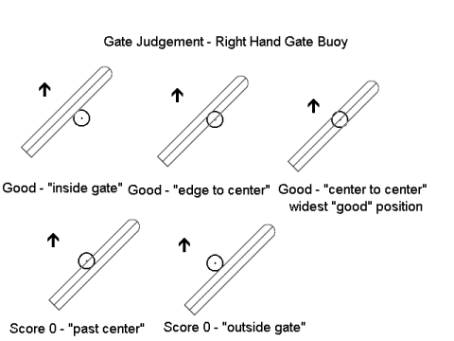
A skier shall be judged as missing
the entry or exit gate when the center of the ski passes to the outside of the
center of the gate buoy as shown in the diagram below:
14.07: Scoring Buoys
A buoy not missed is
scored as follows, up to the point of the first miss:
a) 1/4 point when the
skier crosses the line C-D AND the X-Y line in a skiing position (12.03). (See sketch).
b) 1/2 point when the
skier has re-crossed line C-D in skiing position (12.03) before the level of
the next buoy or end gate.
c) 1 point when the
skier has crossed the line of the gate buoys (on a tight line under
power of the boat) before passing the level of the next buoy (or the end
gate in the case of the final buoy) without falling (12.02). (2007)
The intent of the tight line is to ensure the safety of the skier.
This means that if the skier can only cross the line of the buoys with a slack
line then he will not get the full point so there is no reason to try
that. The end gate case is different because of the spacing and thus if
the skier can cross the gate line before the end gate buoy and ski away he will
be awarded the full buoy. (2007)
A gate is not scored in
any manner.

14.08: The end of the
run
A contestant in either a
preliminary or final round may continue to run the course as provided in 14.01 until he misses a buoy,
entrance or end gate or fall, at which point his scoring ends for that round.
14.09: Event Scoring and
Placement (2009)
Event placement for
skiers qualifying for the final round will be based on their final round
results only. The contestant with the highest score shall be the winner.
Six points shall be
added to the contestant's score for each pass he elects to waive under the
provisions of 14.01 provided his first pass
is perfect. In the Men's finals, each contestant shall be required to waive at
least three passes and six points
shall be added to the contestant's score for each pass he elects to waive, as
well as eighteen points for the three he was required to
waive, provided his first pass is perfect. In the Women's finals, each
contestant shall be required to waive at least two passes and twelve points shall be added
to the contestant's score for each pass she elects to waive as well as the two she was required to waive,
provided her first pass is perfect. A contestant who waives one or more passes
and whose first pass is not perfect shall receive only the points scored in
that pass without additions for the passes waived.
14.10: Ties
If a tie exists for
first place, it shall be run off. If a tie exists for 2nd or 3rd place,
placement shall be decided on the basis of the higher preliminary round score.
If a tie still exists, it shall be run off. The run off shall have a new
drawing for order.
The tie breaking run
shall begin with the scheduled speed and rope length of the last complete pass
and conclude with the first miss. If another tie results, the tie shall be run
off in the same manner with another new drawing for order. This process shall
be repeated until a winner is determined. The skier may optionally skip any
pass in the run-off.
14.11: Slalom Judging
Depending
on technology available there are different ways of Judging slalom
5 Judges
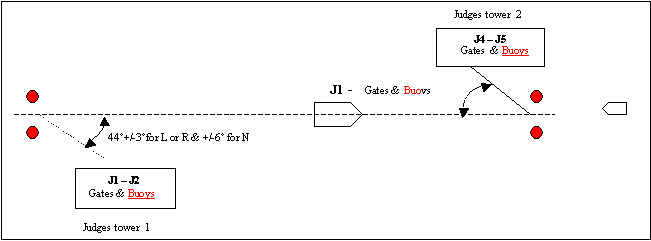

There shall be a Judge
in the boat and two Judges in each of the slalom judging towers. The entrance
and exit gates shall be judged by the two Judges closest to each gate and by
the Boat Judge. Skier buoys shall be judged by all five Judges.
At the end of each run,
the judges' will score the run as follows:
a) The first decision to
be made will be if the skier has gone through the entry gate. That decision
will be made by the appropriate three judges as specified above.
b) The second decision
to be made is the skier's score by buoy count. A judge who might have felt that
the skier missed the gate and thus scored 0 will continue scoring and state his
final score as O with a continuation of X buoys where X is the score that he
would have given the skier if he felt that the gate had been made.
c) The scorer will first
determine if the skier was judged as having made the gate. If the skier made
the gate, the scorer will then award to the skier the highest score agreed upon
by the judges based on their submitted scores. Thus if the scores are 1, 1,
3.25, 3.50, 3.50, the skier's final score is 3.25.
The scores called in by
the judges will be considered final.
The score shall be
finalized before the next competitor is permitted to start.
Gate camera
If it is not feasible to
place a slalom judging towers at the prescribed angle, a video camera may be
mounted at the proper angle and the camera feeds will be displayed on a monitor on
a central judges tower, the Judges can observe the gate and the gate judgment
will made from the monitor. The signal will be taped so that review is
possible. A
pole mounted boat camera may be used in conjunction with normal gate cameras to
get a view that allows the most accurate result.
The central Judges tower
needs to be placed between buoy 2 and 5 on the relative gate-side of the course.
The size ratio of the gate buoys on the TV
screen shall be 1/6th of the full width of the screen minimum with
1/3rd recommended.
Video gate review may be done at normal speed,
slow motion or frame by frame in order to get the right score.
4 Judges with gate video


To use this Judging method all of
the following need to be meet
·
Each gate must be
judged by two judges using video feeds from cameras placed at the required
angle to the gates at each end. These camera feeds will be displayed on a
monitor and taped. Each Judge will independently call the entrance gate by
observing the monitor. In this case only the tower judges determine the gate
call. If one or both judges did not observe the entrance gage then the judge
would replay the video to make the call. If both Judges disagreed the Chief
Judge will cast the deciding vote. The exit gate will be viewed directly but
the video may be used by one or both judges to resolve any questions.
·
The skier buoy
count will be made by the boat judge and two judges, one on each side of the
lake in a symmetrical placement and within 44 degrees (or buoy 2) to the centre
of the course. Unless boat video is used where the two shore judges may be on
the same side in a central location between buoy 3 and 4 with the same height
requirements.
4a Judges with video
gate and boat video


When boat video is used, the boat video will be
monitored on the tower by
another judge who will advise the Chief Judge if he disagrees with the event
judges decision. In which case the Chief Judge and the review judge will again
review the tape to determine which score is correct.. If they both agree on a score, that will be the given score. If they disagree or agree that
the video does not clearly overrule the score given by the judges, then that
score will stand.
If
no other Judges are available the Chief Judge may act as boat video review
Judge, and in case he disagrees with the event judges decision he will ask to
the Judges to look at the video and the score will be decided on video by
simple majority.
(2008)
If a
skier/Team Representative believes that there was an error in a score, he may
challenge it by notifiying the Chief Judge before the next skier goes goes out (or as soon as is
judged practicable by the Judges) and by putting up SF250US$250. The Chief
Judge and a designated review judge will review the video (boat video or gate
video). If they both agree on a score, that will be the given score. If
they disagree or agree that the video does not clearly overrule the score given
by the judges, then that score will stand. The SF250 US$250 will only
be returned if the original score was changed.
The boat Judge shall
observe the boat path. If any part of the boat deviates outside the bounds of
the boat gates, the boat judge shall award an optional reride if the path of
deviation was a disadvantage to the skier. If it was to the skier's advantage,
a reride is mandatory.
See also Rule 14.15 End
Course Video
14.12: Re Run
If the skier has an imperfect pass, the boat judge
shall determine, by appropriate means, whether the skier wishes to take a
rerun. If a rerun is to be taken, the boat shall immediately return through the
course in an unscored pass; and the rerun shall then follow in the original
direction through the course.
If there are more than two (2) rerides, the skier
shall have the option of requesting a five-minute rest before continuing. The rest time will not be
allowed to affect the skiing order if it is seeded or in the finals of a major
tournament. (2008)
14.13: Damaged Equipment
(20097)
Between the start dock
and the gate buoys on the first pass if
a skier notices that his equipment is damaged, the Event Judges may grant him 3
minutes to repair or change the broken equipment and to continue competing. Once a skier has
entered the slalom course on the first pass there is no time given to repair
damaged equipment unless the skier has damaged his equipment during a run that
leads to a re-ride (for example hitting debris or other floating object) he must be back on his skis within 3 minutes from
the time the reride has been granted or he is not allowed to continue in the
round. If the skier is not
able to continue, in the case of a mandatory reride, the pass that brought
about the reride is scored to the last good buoy time.
If the skier is not able to continue, in the case
of an optional reride (and the skier is not back on his skis within 3 minutes),
he is credited with the score obtained in the run that brought about the
reride. “
If a skier has damaged
his equipment during a run that leads to a reride, he must be back on his skis
within 3 minutes from the time the reride has been granted or he is not allowed
to continue in the round. If
the skier is not able to continue, in the case of a mandatory reride, the pass
that brought about the reride is scored to the last good buoy time.
If the skier is not able to continue, in the case
of an optional reride (and the skier is not back on his skis within 3 minutes),
he is credited with the score obtained in the run that brought about the
reride.
14.14: Safety Equipment
All contestants in Slalom events shall be required to wear an approved
life jacket (7.03).
14.15: End Course Video
End-course video shall
be recorded for the slalom event for all passes 12m and shorter. A rigidly
mounted video camera shall be operated from a point on the centerline on at
least one end of the slalom course, adjusted to show all of the boat guides in
clear focus, and equipped with optical (not digital) magnification of
sufficient power to display the far entrance/exit gate occupying at least 1/6th
of the full width of the screen (1/3 width or larger is recommended).
It is recommended that the end course video be
monitored from the judges tower and any driving corrections needed communicated
to the driver. (2006)
A black 5 cm (approx) wide strip up the middle of
the windshield will be used to show up on the end course video. If the boat
already has a visible center mark on the windshield this is not necessary. A
visible mark would be a center seam between two halves of the windshield or a
center swing out window that would have vertical seams on either side of
center. The mark, if required would only need to come up approximately half way
to the top of the windshield, but be clearly visible in the end course video.
The video tape shall be
forwarded to the Region Tournament Council for monitoring immediately after the
tournament. The Council may cancel results that do not conform to rules 1.11, 14.01 , 14.03 and 14.11.
The Chief Judge may assign
an end-course judge to monitor the end-course video and award rerides on the
following criteria:
If the center of the boat deviates more than 20cm
from the center of the course, the end-course judge shall award an optional
reride if the path of deviation was a disadvantage to the skier. If it was to
the skier's advantage, a reride is mandatory. If it had no effect, a reride
will not be awarded. It shall be considered an advantage if the boat deviates
outside the 20cm toward the buoy that the skier is attempting to get around
thus making it easier for him to get to the buoy. It shall be considered a
disadvantage if the boat deviates outside the 20cm away from the buoy that the
skier is attempting to get around thus making it harder for him to get to the
buoy. It shall be considered no effect if the deviation happened in a part of
the pass where the skier was not in the process of attempting to round a buoy.
The reride will be awarded if the end-course judge and the Chief Judge agree on
the determination. The skier's score up to the point of the illegal deviation
shall be protected assuming all other rules criteria have been met (time).
14.16: Driver Times (2007)
An additional tolerance for times shall be set
to ensure that times are as close to actual as possible. Failure to be in
tolerance would not result any re-rides for the skier, but the Driver would be
warned to bring his times to within the limits or face removal from the boat if
these were consistently not achieved. The Boat Judge and Chief Judge will
monitor the drivers performance and ability to stay within the drivers
tolerance and take appropriate action.
|
BOAT SPD |
Score: |
All 6 |
|
KPH |
Fm/To: |
E-X |
|
|
|
|
|
|
Fast |
16.04 |
|
58 |
Ideal |
16.08 |
|
|
Slow |
16.12 |
|
|
|
|
|
|
Fast |
16.90 |
|
55 |
Ideal |
16.95 |
|
|
Slow |
17.00 |